Quick Answer: How Much Does Amazon FBA Cost in Canada?
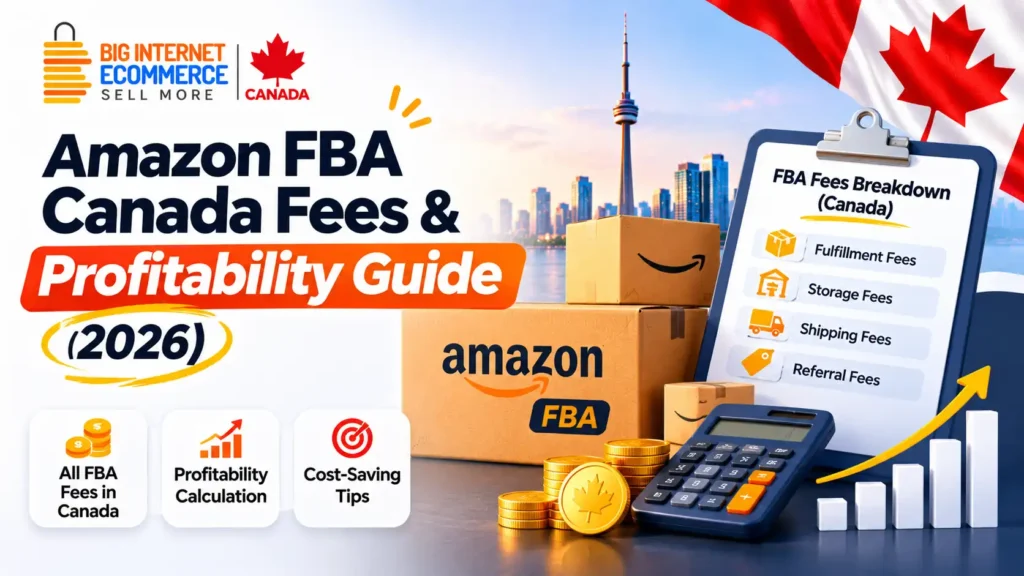
Amazon FBA Canada fees vary with the product’s size tier, shipping weight, price and services used. Sellers may pay a per-unit FBA fulfilment charge, monthly inventory storage fees, Amazon referral fees, selling-plan charges and any applicable additional fees. Amazon Canada’s current public pricing page lists selected standard-size FBA fulfilment fees starting at CAD $5.92 for the first 100 g and envelope fees starting at CAD $4.46 for the first 100 g, subject to classification and current rate rules. Standard-size inventory storage is publicly listed at CAD $40 per cubic metre from January through September and CAD $77 per cubic metre from October through December.
FBA profitability Know your real profit on every unit.
Get a Profitability Review →Those figures are a starting reference, not a quote for your product. Oversize products, high storage utilization, aged stock, returns, removal orders, inbound-placement options and other factors can change the total. The practical next step is to run each ASIN through Amazon’s current Revenue Calculator, then include product cost, inbound shipping and advertising in a complete contribution-margin model.
This Amazon FBA Canada 2026 guide explains how the programme works, what fee categories mean, when FBM may be better, and how to keep fulfilment costs from undermining a healthy-looking sales report.
Need help understanding your Amazon account? Request an Amazon Growth Audit with BIE. Our work can include agreed account operations, listing, advertising and inventory-related coordination, not a promise that any fulfilment programme will be profitable.
What Is Amazon FBA Canada?
Fulfilment by Amazon (FBA) is a programme in which eligible sellers send inventory to Amazon’s fulfilment centres and Amazon handles storage, order picking, packing, shipping and relevant customer-service and returns operations for those FBA orders. The seller still owns the product and remains responsible for product compliance, stock decisions, pricing and account management. FBA is a fulfilment method, not an agency, a separate business licence or a guarantee of Prime placement for every offer.
For Canadian Amazon businesses, FBA can simplify fulfilment operations and offer delivery capabilities that may be difficult to reproduce independently. But the convenience comes at a cost. A seller must understand how per-unit fees interact with selling price and how slow-moving inventory affects storage and cash flow. There is no universal answer that FBA is always cheaper than seller fulfilment.
Amazon’s official FBA pages describe how fees are estimated and how sellers can compare Amazon fulfilment against their own logistics in the Revenue Calculator. The calculator is essential because a package’s size tier and shipping weight can change the cost materially. Official Amazon FBA Canada page.
How Does Amazon FBA Work for Canadian Sellers?
The basic workflow begins with an eligible product and an active seller account. The seller creates or matches an accurate listing, configures the fulfilment method, prepares the inventory according to Amazon’s requirements, creates the appropriate shipment plan and sends stock to the designated destination. Once received and available for sale, Amazon handles eligible customer orders under FBA.
However, the seller’s work does not stop when boxes leave the warehouse. The business must monitor receiving discrepancies, inventory availability, customer returns, stock age and reordering decisions. A product that sells quickly can create stockout risk if the team waits too long to replenish it. A product that sells slowly can accumulate storage and other fees even when no new orders arrive.
FBA Workflow at a Glance
- Verify product eligibility and listing accuracy in Seller Central.
- Determine the correct product and package dimensions and shipping weight.
- Compare estimated FBA and self-fulfilment costs.
- Prepare labels, carton details and shipment data as required.
- Send eligible stock using the current inbound workflow.
- Monitor receiving and available inventory in Seller Central.
- Review fees, sales, returns and inventory age regularly.
- Coordinate replenishment based on demand, margins and lead times.
Do not assume every product type is eligible. Restrictions, dangerous goods rules and special preparation requirements can apply. Amazon FBA for beginners.
Every Amazon FBA Canada Fee You Should Understand
A realistic Amazon FBA cost Canada calculation includes more than one fulfilment charge. A product can have an acceptable sale price and still deliver weak cash profit if the business ignores storage, returns and advertising. Separate Amazon charges from your own operating costs so you can see which decisions you can influence.
| Cost type | What it means | When it matters |
|---|---|---|
| FBA per-unit fulfilment | Picking, packing, shipping and related FBA service elements | Each eligible FBA unit sold |
| Monthly inventory storage | Space occupied in Amazon fulfilment centres | Every month inventory is stored |
| Aged inventory | Additional charges for inventory stored beyond policy thresholds | Slow-moving inventory |
| Inbound placement or shipment | Applicable service charges and seller-paid inbound transport | Sending stock to Amazon |
| Removal/disposal | Fees for returning or disposing of inventory | Unsold, unsuitable or ageing stock |
| Returns processing | Charges that may apply to specific return scenarios | Returned items and applicable categories |
| Referral fee | Amazon’s marketplace referral charge based on category and price | Each sale, whether FBA or FBM |
| Selling plan | Individual per-unit or Professional monthly charge | Account subscription and sales |
| Advertising | Sponsored Products and other optional ad activity | When running eligible campaigns |
| Product/landed cost | Manufacturing or purchase, packaging, freight, duties where applicable | Every unit sourced and replenished |
| Agency or software | Optional outside management and tool costs | When the business purchases such support |
A major source of confusion is calling every Amazon charge an “FBA fee.” Referral fees and seller-plan fees are not the same as per-unit fulfilment fees. They may apply to an FBM sale as well. Advertising is another separate investment, and an agency retainer is not charged by Amazon for FBA.
Amazon FBA Fulfilment Fees in Canada: Public Rate Examples
Amazon Canada publishes fulfilment rate tables by package size and shipping weight. The selected figures below reflect its public pricing page reviewed in November 2026. They are not an exhaustive fee schedule and do not replace the current Seller Central fee preview for your product. Verify category and dimensions before applying any figure.
| Published size tier | Shipping weight band | Listed fulfilment fee (CAD) |
|---|---|---|
| Envelope | First 100 g | $4.46 |
| Envelope | 100+ to 200 g | $4.71 |
| Envelope | 200+ to 300 g | $5.01 |
| Envelope | 300+ to 400 g | $5.28 |
| Standard | First 100 g | $5.92 |
| Standard | 100+ to 200 g | $6.12 |
| Standard | 200+ to 300 g | $6.36 |
| Standard | 300+ to 400 g | $6.73 |
| Standard | 400+ to 500 g | $7.23 |
| Standard | 900+ to 1,000 g | $8.49 |
| Small oversize | First 500 g | $15.43 |
| Medium oversize | First 500 g | $37.78 |
Important: The exact product classification determines which row applies. Higher-weight or other size tiers have additional rules. Amazon’s public pricing material also describes a CAD $0.80 reduction versus standard FBA rates for eligible products priced below CAD $14; verify all qualifying conditions before modelling that benefit. This is not an offer that applies to every low-price product without exception. Amazon Canada fee table.
What Is Shipping Weight?
Amazon’s current public notes describe shipping weight using the greater of actual weight and dimensional weight, subject to its programme rules. Packaging can change dimensions enough to move a product into a more expensive tier. Measure the product as it will actually be prepared for fulfilment, not the dimensions shown in marketing photography. Verify the measurements in Seller Central after any packaging redesign.
Why a Small Change in Packaging Can Matter
Consider two versions of a product sold at the same retail price. One fits into a qualifying standard-size package; the other needs a larger box that changes the FBA tier. Even if the product itself is identical, the larger package may create higher fulfilment and storage costs. Before ordering thousands of cartons, compare the finished-package dimensions with Amazon’s current size-tier rules and shipping weight calculations.
Amazon FBA Storage Fees Canada: Monthly and Seasonal Charges
Amazon charges inventory storage based on the space occupied in its fulfilment centres, with its current public Canadian fee table using cubic metres. Storage fees can change seasonally. This is important for sellers preparing holiday inventory because the final quarter has a different listed rate.
| Inventory category | January–September | October–December |
|---|---|---|
| Standard-size and envelope | CAD $40 per cubic metre | CAD $77 per cubic metre |
| Oversize | CAD $28 per cubic metre | CAD $49 per cubic metre |
Amazon calculates storage using the daily average occupied volume over the month and may apply additional fees for aged inventory and high storage utilization. Therefore, a shipment that arrives or leaves mid-month can affect the charged volume. Do not multiply one day’s stock count by a monthly rate and treat it as a final invoice amount. Current Amazon Canada pricing.
Simple Storage Example
If a hypothetical standard-size stock position occupied an average of 0.25 cubic metres in a January month, the simplified base storage illustration would be 0.25 × CAD $40 = CAD $10 for the month before other applicable charges. In an October month, the same simplified occupied volume at CAD $77 would imply CAD $19.25 in base storage. Real billing is calculated from actual average volume and account-specific fees.
Aged Inventory Is Different From Normal Storage
Amazon’s public FBA guidance says additional aged-inventory fees can apply to units stored longer than 181 days, with exact current thresholds and exceptions determined by its programme documentation. These charges are in addition to ordinary storage, not a replacement for it. Slow-moving products need regular review: discounting, return-to-seller, removal or other decisions may sometimes be more economical than leaving stock indefinitely.
Referral Fees, Account Plans and Other Selling Costs
An FBA seller still pays relevant Amazon referral fees Canada and account-plan charges. Referral rates vary by product category and sometimes the selling price. Use the correct category and published schedule instead of assuming a single referral percentage. The Amazon Individual plan is currently CAD $1.49 per unit sold, while the Professional plan is CAD $29.99 per month, plus selling fees in both cases.
| Selling plan | Listed charge | What to remember |
|---|---|---|
| Individual | CAD $1.49/item sold | Separate from referral and fulfilment fees |
| Professional | CAD $29.99/month | Separate from referral, FBA, storage and ads |
Some additional charges depend on the product and account. The public pricing page identifies examples including certain dangerous-goods surcharges, refund administration fees and other programme fees. A published line item should not be treated as applicable to all sellers; verify its conditions. Amazon Canada pricing.
Calculate FBA Profit: Three Illustrative Product Scenarios
A proper Amazon FBA profit calculator Canada model starts with product revenue and subtracts variable costs. If you want to know what remains for overhead or profit, do not stop at the difference between sales and Amazon fulfilment fees. Include product and landed cost, returns, ads and any costs attributable to selling the unit.
Illustrative contribution margin = selling price − referral fee − FBA fulfilment − landed product cost − allocated inbound freight − returns allowance − advertising allowance − other unit-variable costs. Subscription and fixed agency costs can be allocated separately if the business wants a fuller product-level profit view.
The following numbers are hypothetical planning examples, not confirmed Amazon fee calculations. They intentionally use assumed referral and fulfilment expenses so that sellers can see the logic; the live Revenue Calculator should replace these placeholders.
| Scenario | Selling price | Assumed variable costs excluding advertising | Advertising allowance | Illustrative contribution |
|---|---|---|---|---|
| Compact accessory | CAD $24.99 | CAD $16.00 | CAD $3.00 | CAD $5.99 |
| Mid-price home product | CAD $49.99 | CAD $33.00 | CAD $6.00 | CAD $10.99 |
| Heavy low-margin item | CAD $59.99 | CAD $55.00 | CAD $5.00 | CAD -$0.01 |
This table shows why the fee category and actual packaging matter. The third hypothetical product generates almost no contribution after the assumed ad allowance, despite having a substantially higher selling price. Without a cost model, a seller could scale revenue and still damage profitability.
Break-Even ACoS: A Useful Advertising Planning Tool
One practical question is how much advertising the product can support before its variable margin disappears. A simplified break-even ACoS can be estimated from contribution available before advertising divided by selling price. Suppose a hypothetical product sells for CAD $40 and has CAD $12 remaining after non-ad variable costs. The simplified break-even ACoS would be 30% (12 ÷ 40). That is not a universal target because returns, business overhead, repeat purchases, attribution and other details may matter.
A business should use its own numbers and a consistent reporting period. ROAS is not profit: it compares attributed ad sales with spend, without automatically subtracting product, referral, FBA or operating costs. For ongoing ad strategy, see Amazon PPC Management Canada.
How to Use Amazon’s Revenue Calculator Correctly
Amazon’s Revenue Calculator allows sellers to model a product by catalogue match or by entering relevant details such as weight, dimensions, category and price. Compare Amazon fulfilment with your own fulfilment method using the actual planned charges. Update the inputs when packaging, pricing or costs change rather than reusing a calculation from an earlier year.
Revenue Calculator Workflow
-
Find the correct existing product or define a new product with reliable specifications.
-
Confirm category and package dimensions, including shipping weight.
-
Enter the intended selling price and relevant product costs.
-
Compare estimated Amazon fulfilment and seller fulfilment costs.
-
Add inbound freight, storage assumptions, advertising and return allowances to your internal worksheet.
-
Repeat the calculation for different prices and demand scenarios.
-
Confirm actual fees through Seller Central reports when the product is live.
The calculator is an estimate, not a financial guarantee. Amazon also provides Fee Preview tools and relevant reports inside Seller Central. Amazon fee-estimation guidance.
Amazon FBA vs FBM in Canada: Which Is Better?
The difference between FBA and FBM Canada is primarily who handles fulfilment, but that choice changes service expectations, control, cash flow and inventory planning. Under FBA, Amazon stores and ships eligible inventory. Under FBM, the seller or a contracted logistics provider fulfils orders according to its shipping and account responsibilities. Neither method is universally cheaper.
| Decision factor | FBA | FBM |
|---|---|---|
| Storage | Amazon fulfilment network | Your storage arrangement |
| Shipping execution | Amazon’s FBA operation | Seller or external fulfilment partner |
| Delivery capability | Subject to FBA programme features and eligibility | Depends on seller/carrier service levels |
| Cost structure | FBA unit fees, storage and applicable extras | Pick/pack, postage, warehouse and service costs |
| Stock control | Requires inbound planning and Amazon inventory monitoring | More direct control over physical inventory |
| Returns handling | Relevant FBA customer-service and returns processes | Seller responsibilities under applicable rules |
| Best fit | Products with favourable size, margin and turnover | Products suited to own logistics or specialized handling |
When FBA Can Make Sense
FBA may be worth evaluating for products with suitable size and margins where reliable fulfilment, customer service and service features justify the fees. A brand that lacks its own warehouse operation may value a more standardized order flow. But it still needs a replenishment plan and enough cash to fund inventory before sales occur.
When FBM Can Make Sense
FBM may be attractive when the seller has efficient logistics, unusual or bulky products, or a reason to retain direct control over handling. It can also avoid some Amazon storage costs, but the seller still has its own warehouse, carrier, return and customer-service expenses. Compare total costs rather than assuming FBM shipping is free because it is not charged as an FBA line item.
Can a Seller Use Both Methods?
Depending on account and product configuration, a business can evaluate different fulfilment approaches across its catalogue. The decision may vary by ASIN, season or availability. Avoid creating conflicting offers or assuming a change can be made without operational planning. Amazon’s FBM overview.
We help you model fees, costs and margins so growth does not cost you profit.
- Review fees and landed costs
- Find margin leaks early
- No Amazon password needed to enquire
Who Is a Good Fit for Amazon FBA Canada?
There is no automatic “best product for FBA” list that applies across every seller. A promising candidate usually has accurate product information, acceptable fulfilment dimensions, sufficient contribution margin and manageable inventory turnover. Category competition and supply stability also matter because an FBA SKU can generate fees even when sales are slow.
Compact, Lightweight Products
A compact item may have more favourable fulfilment and storage economics than a similar-priced bulky one, depending on the actual size tier. But low price can also limit the margin available after referral and other charges. Model both sides.
Established Products With Predictable Demand
A SKU with reliable historical sales may be easier to replenish. Historical demand is still not a guarantee: competition, price, seasonality and ad activity can change. Review weeks of cover and supplier lead times.
Brands Without Dedicated Warehouses
FBA can simplify certain fulfilment tasks for a brand that lacks its own shipping operation. The brand must still coordinate inventory preparation, inbound shipping, cash flow and catalogue accuracy.
Products That May Need More Caution
Bulky items, fragile goods, products with restrictive handling rules and slow-moving inventory deserve careful modelling. A product may be eligible but commercially unattractive after fulfilment, storage and damage/return allowances. Compliance must be confirmed separately from profitability.
Step-by-Step: Prepare Your First FBA Shipment
Step 1: Confirm the offer and account. Register the correct seller account, create an accurate product listing and verify FBA eligibility. Seller Central provides the current workflow and any restrictions relevant to the SKU.
Step 2: Measure the packaged product. Use actual prepared dimensions and weight, not only manufacturer brochure figures. The resulting size tier affects fee estimates and may affect preparation requirements.
Step 3: Review labelling and preparation. Confirm the barcode method, carton details and any prep requirements in Seller Central. A mistake can create receiving delays or unexpected service costs.
Step 4: Estimate the complete landed cost. Include product, preparation, inbound shipping and potential placement-related charges, not just the unit fulfilment fee.
Step 5: Create the shipment plan. Follow the current Send to Amazon or other applicable shipment workflow. Routing, placement and documentation options can change; follow what the account actually displays.
Step 6: Send inventory and retain records. Keep shipment, carton and carrier information, and monitor receiving discrepancies through the supported support process.
Step 7: Watch inventory and fees after receipt. Confirm the units become available, compare estimated and actual expenses, and review early customer feedback and returns.
Do not assume that handing inventory to a carrier ends the seller’s responsibility. Someone should own open inbound cases and inventory follow-up. Amazon FBA Canada.
Inventory Planning: Avoid Stockouts and Storage Surprises
FBA changes the economics of inventory because the seller pays for stock before selling it and may also pay to store it. Too little stock can interrupt sales and advertising. Too much stock ties up cash and may attract storage or aged-inventory charges. The goal is a measured replenishment policy, not the highest possible stock count.
A simple replenishment model can consider average daily demand × total replenishment lead time, plus an appropriate safety stock assumption. Suppose a product sells 4 units per day and the full restock cycle takes 25 days; the base lead-time demand would be about 100 units before buffer adjustments. The example is intentionally simple. Seasonal demand, supply variability, shipping delays and product launch uncertainty may require different treatment.
Track inbound units, available inventory, reserved stock and any stranded units separately. Inventory dashboards should be reviewed alongside advertising planning. If a product has only a short runway of stock, an aggressive campaign budget may not be commercially sensible.
Storage-Control Actions Worth Considering
- Review the age and sell-through of every important SKU.
- Compare sales forecasts with current available inventory.
- Inspect products approaching relevant ageing thresholds.
- Identify unexpected stock accumulation after promotions end.
- Review removal or other options using their actual fees and product condition.
- Coordinate PPC and promotions with stock availability.
- Recalculate margins after Amazon changes rates or the package format.
FBA Returns, Reimbursements and Account Health
Returns are part of ecommerce and should be included in profitability analysis. For some products, return frequency or handling requirements materially change the economics. Amazon provides relevant FBA customer-service and returns functions, but sellers should still track the financial effect of returns, refunds and unsellable inventory.
If stock is lost, damaged or disputed, the seller should use the appropriate Amazon programme and case process, verify eligibility and retain evidence. No outside provider can guarantee reimbursements. Seller Support follow-up should be documented with case references and a clear owner.
Accurate product detail information can reduce customer confusion, although a listing edit alone cannot guarantee fewer returns. Product dimensions, package contents and compatibility should match the actual item. For relevant support, review Amazon Account Management Services Canada and Amazon Listing Optimization.
Amazon PPC and FBA: Why the Two Need to Be Coordinated
An FBA product can be eligible for advertising, but a strong-looking campaign is not evidence of product profitability. The brand needs to connect paid traffic with its fulfilment cost, stock level and available contribution margin. Campaigns should also be reviewed when prices, returns or inventory change, because the economics that supported an earlier bid may no longer apply.
For example, a seller may see a 4.0 ROAS and assume the campaign is highly profitable. If the product’s combined referral, FBA, landed cost and returns allowance consume most of revenue, the apparent advertising efficiency may still leave little contribution. A practical Amazon PPC strategy for FBA sellers uses product-level margins to inform ACoS targets and budgets.
Advertising and Inventory Coordination Checklist
- Prioritize SKUs with acceptable, verified contribution margins.
- Check availability before significant advertising increases.
- Match campaigns to product goals: launch, discovery or efficiency.
- Monitor search terms and wasted spend without overreacting to tiny samples.
- Compare ACoS, ROAS and TACoS with broader sales and profit context.
- Revisit targeting after listing, price or availability changes.
- Keep Amazon.ca and Amazon.com campaign performance separate where appropriate.
BIE offers Amazon PPC Management Canada for eligible brands seeking help with targeting, bids, budgets and reporting. PPC is a separate service from Amazon FBA fees.
Canada-Specific FBA, GST/HST and Cross-Border Considerations
Canadian FBA sellers need to think about more than warehouse fees. Tax, import, compliance and currency factors can affect true landed costs. Applicable GST/HST obligations vary by seller status, transactions and relevant legislation. The CRA explains that digital-economy and distribution-platform rules can affect qualifying goods and marketplace participants. Amazon platform processes should not be treated as a substitute for professional tax analysis.
For cross-border operations, consider who acts as importer, where the inventory is held, the relevant duties, currency conversion, product compliance and the marketplace in which the offer is made. A seller should not assume that an Amazon.ca SKU automatically uses the same fees or regulations on Amazon.com. Cross-border fulfilment programmes have specific eligibility, enrolment and cost structures.
For Quebec-facing products, applicable French-language and labelling requirements should be checked based on product type and business circumstances. Use qualified professional guidance for regulated products, customs and tax questions. CRA digital-economy overview.
Want an expert to apply this to your account? Request a review and get clear next steps.
Get a Profitability Review →How Big Internet Ecommerce Helps With FBA-Related Marketplace Operations
Big Internet Ecommerce (BIE) supports Canadian Amazon brands with account management, catalogue and listing work, advertising, SEO, creative and Vendor Central services. Its Canadian website describes remote support from British Columbia. The agency can discuss scope for coordinating relevant FBA and Seller Central issues, but it is not Amazon’s fulfilment operator and should not be described as guaranteeing fee reductions, inventory outcomes or policy decisions.
A business may need an inventory and account-health review, stronger product detail pages or advertising targets aligned with fulfilment economics. Those are different workstreams that can be coordinated when included in the engagement. For example, improving package information may help customer understanding while a separate cost review examines whether the FBA method still makes sense for the SKU.
Explore related services: Account Management · Amazon PPC · Amazon SEO · Listing Optimization · Case Studies.
Practical Amazon FBA Canada Cost Audit Checklist
Use this checklist before increasing inventory or advertising spend: – Confirm current selling plan and referral category for each ASIN. – Verify actual packaged dimensions, shipping weight and FBA size tier. – Review current per-unit FBA fees rather than relying on last year’s assumptions. – Account for seasonal storage and relevant ageing fees. – Include inbound freight, placement, preparation and returns allowances. – Model contribution margin before and after advertising. – Compare FBA with realistic seller-fulfilment costs. – Review inventory age, stock availability and reorder lead times. – Track returns and unresolved fulfilment issues. – Confirm Canada-specific tax, customs and compliance questions with professionals. – Assign an owner for account, inventory and reporting tasks.
Frequently Asked Questions About Amazon FBA Canada Fees
How much does Amazon FBA cost per item in Canada?
It depends on the product’s size tier, shipping weight, price and applicable services. Amazon Canada publicly lists examples starting at CAD $4.46 for qualifying envelope items in the first 100 g band and CAD $5.92 for qualifying standard-size items in that band. Check your actual ASIN in Seller Central or the Revenue Calculator for the applicable rate.
What are Amazon FBA storage fees in Canada in 2026?
Amazon’s current public Canadian fee table lists standard-size inventory storage at CAD $40 per cubic metre from January to September and CAD $77 per cubic metre from October to December. Oversize rates differ, and extra charges may apply. Your actual fee uses daily average occupied volume and current rules.
Does Amazon FBA include the referral fee?
No. FBA fulfilment is separate from Amazon’s category-based referral fee. The selling-plan charge, optional advertising and other costs are also distinct. Estimate the full cost stack before deciding a product is profitable.
Is Amazon FBA profitable in Canada?
It can be for some products, but profitability is not guaranteed. The seller must compare price with product/landed cost, referral fees, FBA fulfilment, storage, returns, advertising and business overhead. Different ASINs can have very different outcomes.
Is Amazon FBA cheaper than FBM in Canada?
Not universally. FBA may be competitive for suitable products, while FBM may work better when the seller has efficient shipping or handles unusual inventory. Use the Revenue Calculator and your actual warehouse/carrier costs for a fair comparison.
What is the Amazon FBA Revenue Calculator?
It is an Amazon tool for estimating fees, costs and revenue using product information. It can compare Amazon fulfilment with seller fulfilment under entered assumptions. Estimates should be checked against actual reports once the product is live.
Do FBA fees change during the holiday season?
Amazon Canada’s public inventory-storage rates differ between January–September and October–December. Other costs can also depend on the programme and product. Verify the current rate schedule when planning seasonal stock.
When do aged-inventory fees apply?
Amazon’s public FBA guidance describes additional aged-inventory charges for items stored beyond relevant age thresholds, including inventory older than 181 days. Exact fee rules and exemptions should be checked in Seller Central. Ordinary storage fees may continue to apply as well.
Can I use FBA and FBM for different products?
Eligible sellers can evaluate fulfilment choices across their catalogue, subject to account and listing configuration. Select methods using actual product economics and logistical requirements, rather than assuming one approach suits every SKU.
Does FBA mean Amazon owns my products?
For third-party FBA selling, you remain the seller of the products while Amazon provides eligible fulfilment services. This is different from a first-party Vendor Central wholesale relationship. Check account terms and your legal obligations for the specific arrangement.
Do I need a Professional seller plan for FBA?
Review Amazon’s current account-plan and FBA eligibility rules. Both plan choice and product eligibility can affect available tools, and advertising features may depend on a Professional plan. The correct decision depends on your expected units and requirements.
Can I reduce FBA fees by changing packaging?
Sometimes packaging dimensions and shipping weight influence the fee tier. Any change must remain accurate, protect the product and comply with Amazon preparation rules. Recalculate the actual fees before committing to redesigned packaging.
Are Amazon PPC fees included in FBA?
No. Advertising spend is an optional separate cost and is normally measured through the advertising account. An agency’s PPC-management fee is also separate from FBA and selling fees. Use product margins to set realistic advertising targets.
Are FBA returns free for sellers?
Do not assume that. Returns can create financial costs, and some return-processing or other charges can apply according to category and programme rules. Review current Amazon terms and actual account reports.
How does GST/HST affect Amazon FBA sellers?
Canadian GST/HST obligations depend on registration, the transactions and the applicable laws. FBA inventory location and marketplace arrangements may be relevant in some situations. Review CRA guidance and obtain qualified advice for your business’s facts.
Can BIE manage my FBA inventory and account issues?
BIE offers account management and inventory-related coordination subject to a defined agreement. Its services can also connect PPC, SEO and listing work. The agency does not operate Amazon’s warehouses or guarantee reimbursement, account approvals or inventory performance.
How do I start FBA in Canada?
Create or use an eligible Seller Central account, confirm product eligibility, create accurate listings, estimate costs, prepare inventory and follow the current Amazon shipment workflow. Monitor the inventory after receiving and regularly review fees and account health.
What is the difference between Amazon FBA and Vendor Central?
FBA is a fulfilment method available for eligible third-party selling accounts. Vendor Central is a separate first-party wholesale relationship in which brands sell products to Amazon. Purchase-order and financial processes differ.
Conclusion: Know the Full FBA Cost Before You Scale
Amazon FBA Canada can simplify parts of order fulfilment, but its value depends on the economics of each product and the quality of the inventory plan. Your margin calculation should include referral, per-unit fulfilment, storage, inbound, returns, advertising and other relevant costs—not only a simplified fee estimate. Use actual package measurements and current Amazon reports whenever possible.
For an existing Canadian Amazon brand, fulfilment decisions also need to connect with listing accuracy, demand and PPC. If your team needs help reviewing these connected priorities, request an Amazon Growth Audit with Big Internet Ecommerce or contact BIE for an appropriate scope.
Sources and Editorial Notes
- Amazon Canada, Fulfilment by Amazon
- Amazon Canada, Selling Fees and FBA Rate Tables
- Amazon Canada, Estimate Costs
- Amazon Canada, FBA for Beginners
- Amazon Canada, Fulfilled by Merchant
- CRA, GST/HST for Digital-Economy Businesses
Editorial disclosure: Big Internet Ecommerce publishes this article and offers relevant Amazon services. Public fee values were reviewed against Amazon Canada’s pages in November 2026 and can change. The scenario tables are hypothetical, not quotes or average results.
We help you model fees, costs and margins so growth does not cost you profit.
- Review fees and landed costs
- Find margin leaks early
- No Amazon password needed to enquire
Prefer email? amz@biginternetcommerce.com