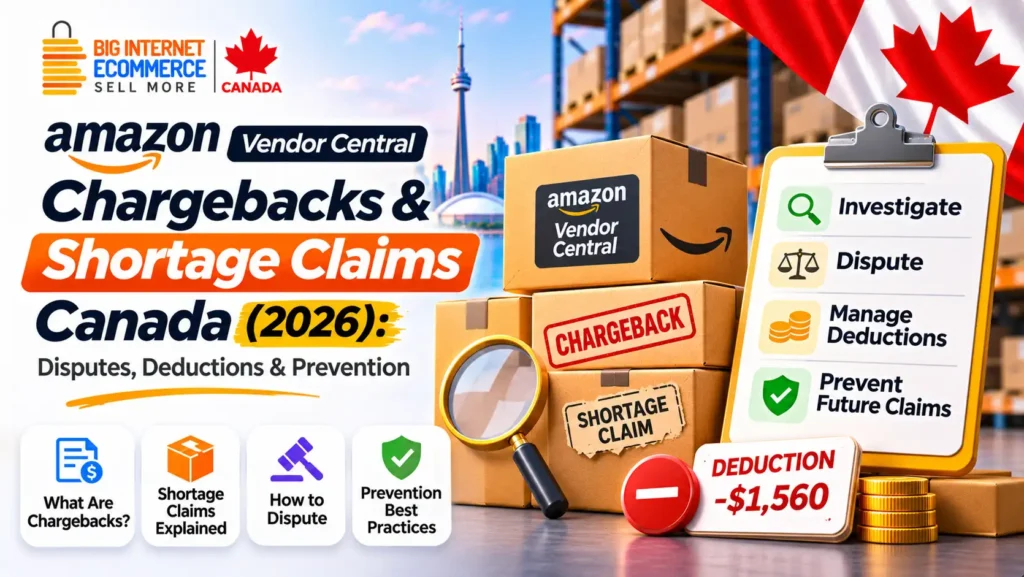
Quick answer: Amazon Vendor Central chargebacks are operational deductions Amazon may apply when a first-party vendor fails to meet applicable purchase-order, shipping, packaging, labelling or receiving requirements. Amazon shortage claims are different: they generally arise when Amazon cannot reconcile the quantities invoiced by a vendor with the products recorded as received. To investigate either issue, review the deduction in Vendor Central, match the purchase order (PO), advance shipment notification (ASN), shipping documents, invoice and receipt records, then use the appropriate Dispute Management workflow. In 2026, eligible shortage disputes may also use a newer reopen process rather than the older separate re-dispute workflow. Always verify the current Canadian account rules and deadlines before submitting.
Vendor Central Stop deductions from eating your margin.
Request a Vendor Central Audit →A manufacturer can ship products to Amazon, receive delivery confirmation and still encounter an unexpected deduction from its wholesale payment.
The goods may have left the warehouse on time. The invoice may appear correct. The carrier may confirm delivery.
Yet Amazon Vendor Central shows a shortage claim, a compliance chargeback or another invoice adjustment.
For brands operating on Amazon.ca, these issues can become expensive when they occur repeatedly.
The problem isn’t always a genuinely missing product. Sometimes purchase-order data, carton contents, advance shipment notifications or receiving records don’t match.
A vendor may also receive a chargeback because a shipment didn’t follow an applicable operational requirement.
When these issues remain unresolved, they can complicate cash-flow forecasting, financial reconciliation and inventory planning.
That’s why Amazon Vendor Central management in Canada requires more than uploading invoices and monitoring sales.
Vendors need accurate purchase orders, shipment records, compliant packaging, reliable data transmission and a systematic process for investigating deductions.
At Big Internet Ecommerce (BIE), we provide Amazon Vendor Central support for eligible first-party brands, manufacturers and distributors.
Our services can include purchase-order coordination, shipment and ASN workflows, invoice follow-up, catalogue operations, retail analytics and deduction-related support within an agreed engagement.
Based in Maple Ridge, British Columbia, BIE works remotely with eligible brands across Canada, including businesses in Vancouver, Toronto, Montreal, Calgary, Ottawa and Edmonton.
This guide explains what Amazon vendor deductions are, how shortage claims differ from operational chargebacks, which documents matter, how disputes work and what vendors can do to prevent recurring financial issues.
Request an Amazon Vendor Central Account Audit
What Is an Amazon Vendor Central Shortage Claim?
An Amazon Vendor Central shortage claim is a deduction associated with a discrepancy between the quantity a vendor invoices and the quantity Amazon records as received or attributable to the relevant purchase order.
For example, a supplier may invoice Amazon for 100 units.
Amazon’s records may initially account for only 96 units.
The difference can create a shortage-related discrepancy.
But that does not automatically prove that four products were lost.
Possible explanations include a physical short shipment, receiving delay, incorrect ASN, product identification mismatch or another data-reconciliation problem.
How Do Shortage Claims Happen?
A typical wholesale transaction involves several records.
Amazon issues a purchase order.
The vendor acknowledges the order.
The warehouse prepares and ships the goods.
An advance shipment notification identifies what was shipped.
Amazon receives and records the products.
The vendor invoices Amazon.
For accurate payment, the relevant records must be matched.
When the invoice quantity and Amazon’s recognized receipt information differ, a shortage claim may arise.
Potential Shortage vs Remaining Shortage
Specialist Vendor Central documentation distinguishes between potential shortages and remaining shortages.
A potential shortage represents a discrepancy that may still be under review or reconciliation.
A remaining shortage is a discrepancy that has not been reconciled through the relevant process.
Vendors should investigate both, but the available action may depend on the current status.
Does a Shortage Claim Mean Amazon Lost the Inventory?
Not necessarily.
The issue may involve physical inventory, data matching or the timing of receipt recognition.
A carrier delivery confirmation can help establish shipment delivery, but it may not independently prove the exact unit-level quantities Amazon received.
A proper investigation compares multiple records.
Amazon Chargebacks vs Shortage Claims vs Price Claims
These terms are sometimes used interchangeably, but they represent different financial issues.
| Deduction type | Main problem | Typical investigation |
|---|---|---|
| Operational chargeback | Failure to meet a relevant shipping, packaging or operational requirement | Review violation code, PO, shipment and compliance evidence |
| Shortage claim | Amazon’s recognized received quantity differs from invoiced quantity | Reconcile PO, ASN, physical shipment, invoice and receipts |
| Price claim | Difference involving an invoiced or agreed price | Review commercial terms, cost records, invoice and effective dates |
| Co-op deduction | Charge associated with an applicable commercial or promotional agreement | Review agreement, calculation and payment records |
| Return-related deduction | Financial adjustment connected to product returns | Review return terms and relevant transactions |
Operational Chargebacks
A chargeback may be applied because a shipment or associated process failed an operational requirement.
For example, an ASN may have been transmitted late or contain information that doesn’t match the physical shipment.
Shortage Claims
A shortage claim concerns the relationship between invoiced products and Amazon’s recognized receipt records.
Price Claims
A price claim may arise where an invoiced cost differs from Amazon’s expected or agreed cost.
That can require reviewing cost changes, effective dates and the applicable commercial agreement.
Co-op and Other Deductions
Some deductions arise from commercial agreements rather than warehouse operations.
These should be analyzed through their own contractual and financial records.
Important: Using the wrong dispute category can slow down the investigation or lead to an inappropriate response.
Common Amazon Vendor Central Chargebacks in 2026
Amazon’s North American Vendor Manual identifies multiple operational chargeback categories.
The exact rules depend on the vendor account, shipment type and current requirements.
1. ASN Visibility and Accuracy Chargebacks
An Advance Shipment Notification (ASN) communicates information about a shipment before it reaches Amazon.
It includes details used to identify and process the shipment.
A missing, late or inaccurate ASN can create receiving problems.
Amazon’s manual explains that ASNs should be transmitted accurately and reach the fulfilment centre before the physical shipment.
How to Reduce ASN Chargebacks
Review the ASN against the actual shipment.
Confirm the product identifiers, quantities, cartons and relevant PO references.
Check that the data was successfully transmitted.
2. No Carton Content Label Chargebacks
Amazon requires appropriate carton identification for relevant shipments.
A missing or non-compliant label can interfere with receiving.
Review the applicable carton-label requirements before shipping.
3. Carton Content Accuracy Chargebacks
Carton Content Accuracy problems can arise when the information describing carton contents doesn’t match the actual products.
For example, the ASN or label may identify one quantity while the carton contains another.
Use carton-level validation to reduce these discrepancies.
4. Purchase Order Confirmation Issues
Amazon expects eligible vendors to acknowledge purchase orders according to their applicable requirements.
Missing or incorrect confirmations can create operational problems.
The vendor should check the PO, confirm the appropriate quantities and follow the stated timeline.
5. PO On-Time Accuracy Chargebacks
Amazon may evaluate whether shipments meet the purchase-order timing requirements.
The appropriate shipping or delivery window depends on the PO and freight arrangement.
A vendor should not use one general timing assumption for every shipment.
6. Late or Incorrect Shipment Activity
Delays, incorrect shipment information or failure to follow routing instructions may lead to operational deductions.
Review the actual shipment requirements.
7. Pickup Accuracy Chargebacks
For applicable collect-freight arrangements, Amazon’s manual identifies Pickup Accuracy as a chargeback category.
A problem can occur when freight is not ready at the scheduled pickup.
8. Overweight or Oversized Cartons
Amazon specifies packaging and shipment requirements.
Cartons that exceed the applicable limits may lead to compliance issues.
Requirements can vary according to product and shipment type.
9. Overage Purchase Order Issues
An overage occurs when shipment quantities exceed the authorized PO or another permitted tolerance.
Shipping additional units without appropriate authorization can create receiving and payment problems.
10. Packaging and Preparation Errors
Products may require particular packaging or preparation.
Incorrect preparation can create receiving difficulties, returns or deductions.
11. Unconfirmed Purchase Orders
Failing to confirm a PO correctly can contribute to operational non-compliance.
12. Direct Import Documentation Issues
Direct Import shipments may have additional documentation, booking and shipment requirements.
For Canadian brands shipping across the US border, the relevant import and commercial documentation must also be considered.
Why Amazon Vendor Central Shortage Claims Happen
Shortage claims are often related to the way shipment and invoice records are matched.
Amazon’s North American Vendor Manual explicitly identifies ASN accuracy and receiving records as important parts of preventing shortage claims.
Incorrect ASN Quantities
The ASN might indicate 120 units while the physical shipment contains 118.
If the invoice also states 120, the records may not reconcile.
Incorrect Product Identifiers
A product may be shipped using an incorrect or inconsistent identifier.
This can make it harder to associate the received goods with the intended PO line.
Incorrect Case-Pack Information
Amazon needs to understand how units are packed and identified.
A case-pack mismatch can create incorrect expected quantities.
Missing Carton-Level Labels
Without appropriate carton identification, receiving may require additional processing.
Shipment Associated With the Wrong PO
Goods may be received but attributed incorrectly.
For example, the ASN may refer to the wrong PO or mix unrelated shipment references.
Delayed Receiving
Amazon may not immediately complete all receiving and reconciliation activities.
A temporary difference doesn’t necessarily establish a permanent shortage.
Warehouse Picking or Packing Errors
A vendor may believe it shipped the expected quantity, while the actual carton contents differ.
Internal warehouse controls should help identify these errors.
Invoice Errors
An invoice may contain an incorrect quantity, item or reference.
Data Integration Errors
EDI or API transmissions can fail or contain inconsistent information.
Cross-Border Shipment Complexity
Direct Import and other cross-border arrangements may involve additional records and handoffs.
The correct workflow depends on the business’s freight terms and applicable requirements.
What Are PO, ASN, BOL, EDI 856 and EDI 810?
Amazon Vendor Central management involves several documents and electronic transaction types.
Understanding them is essential for both dispute investigation and prevention.
| Term | Full meaning | Why it matters |
|---|---|---|
| PO | Purchase Order | Identifies the products and quantities Amazon ordered |
| ASN | Advance Shipment Notification | Communicates the contents of a shipment |
| BOL | Bill of Lading | Records relevant shipment and carrier information |
| POD | Proof of Delivery | Helps document delivery |
| EDI 850 | Purchase Order | Electronic purchase-order message |
| EDI 855 | Purchase Order Acknowledgement | Electronic confirmation of order details |
| EDI 856 | Advance Ship Notice | Electronic shipment-content notification |
| EDI 810 | Invoice | Electronic invoice message |
| SSCC | Serial Shipping Container Code | Identifies a logistics unit |
| AMZNCC | Amazon Container Code | Amazon-specific container identification |
| ARN | Amazon Reference Number | Used in relevant collect-freight routing processes |
Why the ASN Is Important
The ASN helps Amazon associate incoming inventory with the expected shipment contents.
Amazon’s manual explains that incorrect or late ASN information can interfere with receiving records and invoice matching.
Why the BOL Matters
A Bill of Lading can help establish what was handed to the carrier.
However, it may not prove exactly what Amazon received at the unit level.
Why EDI Accuracy Matters
Electronic data interchange can reduce manual processing, but it also requires accurate information.
Automation that repeatedly transmits incorrect quantities can create recurring problems.
Why Carton Labels Matter
Appropriate carton labels help Amazon identify the shipment’s contents.
The identifiers used in the ASN should agree with the physical labels and shipment structure.
How to Find Vendor Central Chargebacks and Shortage Claims
Before creating a dispute, identify the original financial transaction.
Step 1 — Sign In to Vendor Central
Use the authorized Vendor Central account for the relevant marketplace.
For Canadian vendors, ensure the appropriate Amazon.ca vendor account is selected.
Step 2 — Review the Operational Performance Dashboard
Amazon’s North American Vendor Manual identifies the Operational Performance Dashboard as a resource for reviewing chargebacks.
Check the relevant deduction category and details.
Step 3 — Review Invoices and Payments
Use the available payment and invoice tools.
Look for differences between invoiced amounts and recognized payments.
Step 4 — Open Dispute Management
Amazon’s manual identifies Vendor Central’s Dispute Management area as the place to create and review relevant disputes.
Step 5 — Identify the Specific Deduction
Record the relevant:
- Deduction or chargeback ID.
- Invoice number.
- Purchase-order number.
- ASIN or other product identifier.
- Shipment reference.
- Deduction amount.
- Event date.
- Applicable reason code.
- Current status.
Step 6 — Confirm Whether the Deduction Is Final
Some discrepancies may still be undergoing reconciliation.
Review whether the item is currently eligible for dispute.
Step 7 — Compare the Original Records
Check the PO, ASN, invoice and physical shipping evidence.
Step 8 — Record the Financial Impact
Calculate the disputed amount and assess whether the evidence supports further action.
Step 9 — Assign an Owner
A finance, supply-chain or Vendor Central team member should be responsible for the investigation.
Step 10 — Track Resolution
Do not treat the issue as resolved until the relevant financial outcome has been reconciled.
How to Investigate an Amazon Shortage Claim: Step-by-Step
A structured investigation should distinguish a real short shipment from a records problem.
Step 1 — Identify the Shortage
Review the affected invoice and shortage amount.
Step 2 — Find the Original Purchase Order
Check the ordered SKUs, accepted quantities and relevant timing requirements.
Step 3 — Review the PO Acknowledgement
Confirm whether the vendor accepted the full quantity or acknowledged a different amount.
Step 4 — Review the ASN
Verify the reported product IDs, quantities and carton details.
Step 5 — Compare Physical Shipment Records
Use appropriate packing records, warehouse confirmations and shipment documentation.
Step 6 — Review Carrier Information
Check the shipment reference, BOL and applicable delivery records.
Step 7 — Compare Amazon’s Receipt Information
Determine which quantities Amazon recognized and whether the records correspond to the correct PO and shipment.
Step 8 — Review the Invoice
Confirm the invoiced quantity and price.
Step 9 — Identify the Likely Root Cause
Possible causes include a real physical shortage, ASN mismatch, incorrect PO attribution, receiving discrepancy or invoice error.
Step 10 — Determine Whether a Dispute Is Supported
Do not file a claim solely because the deduction is financially inconvenient.
The supporting records should provide a credible basis for the dispute.
Step 11 — Submit Through the Appropriate Workflow
Use the dispute process available in the account.
Step 12 — Track the Final Outcome
Record any approval, denial, partial approval, payment adjustment or remaining balance.
Explore BIE’s Amazon Vendor Central Support
How to Dispute Amazon Vendor Central Chargebacks
Operational chargeback disputes require a different analysis from shortage claims.
The vendor needs to identify the particular rule Amazon says was violated.
Step 1 — Identify the Chargeback Category
Determine whether the issue involves ASN accuracy, carton labels, PO timing, shipment preparation or another requirement.
Step 2 — Review the Applicable Policy
Confirm the exact requirements for the shipment type and relevant account.
Step 3 — Compare the Recorded Violation With Evidence
For an ASN-related deduction, check transmission records and the acknowledged data.
For a carton-label deduction, examine applicable carton-level documentation.
For a timing deduction, review the required shipping window and recorded carrier events.
Step 4 — Determine Whether the Chargeback Is Valid
If the vendor failed to comply, the appropriate action may be to correct the process and account for the charge.
If the deduction appears incorrect, prepare the supporting evidence.
Step 5 — Use Dispute Management
Locate the relevant dispute workflow in Vendor Central.
Follow the current instructions for that category.
Step 6 — Provide an Evidence-Based Explanation
Identify the exact requirement and explain how the available records demonstrate compliance.
Step 7 — Submit Within the Applicable Window
Different deduction categories may have different deadlines.
Use the date and eligibility information shown in the current Vendor Central account.
Step 8 — Track the Decision
Record the outcome and any further action available.
Step 9 — Reconcile the Financial Adjustment
If a chargeback is reversed, confirm the resulting payment adjustment.
Step 10 — Prevent Recurrence
Use the issue to improve the relevant warehouse, EDI, ASN or PO process.
Important 2026 Update: Amazon Shortage Claim Dispute Reopening
The shortage-claim dispute process changed during 2026.
This is particularly important because older online tutorials may describe a separate re-dispute workflow that no longer reflects the current experience.
What Changed?
According to SPS Commerce’s specialist guidance, Amazon introduced a new process during Q3 2026.
Instead of creating a separate re-dispute record, eligible vendors can reopen the original shortage claim dispute.
What Is Different?
Under the newer process described by SPS Commerce:
- The reopen is associated with the original dispute.
- It does not create a separate dispute ID.
- The available reopen control depends on eligibility.
- The reopen explanation is text-based.
- The original disputed amount remains associated with the claim.
- The resolution information may change after review.
What About Attachments?
SPS Commerce reports that the reopen workflow does not support new attachments in the same way as the previous separate re-dispute process.
That makes the quality of the initial evidence particularly important.
Can You Reopen Every Claim?
No.
Amazon determines eligibility.
A claim may be ineligible because of its status, existing payment, previous review or another condition.
What Is the Reopen Deadline?
SPS Commerce reports an approximately two-year North American window linked to the original invoice due date for the initial eligible dispute/reopen process.
It also reports that an eligible second reopen must be submitted within five days of the first reopen’s resolution.
Because reporting and time-zone delays can reduce the practical time available, its guidance recommends acting sooner.
These are third-party descriptions of the workflow, not a substitute for the current official rules displayed in your Vendor Central account.
The actual deadline, eligibility and available controls must be verified directly in the relevant account.
Why Is This Important?
A vendor relying on an outdated tutorial might:
Use the wrong dispute workflow.
Wait too long after a denial.
Assume a new dispute ID will be created.
Expect to upload additional documents when the current reopen process does not allow them.
Fail to reconcile the actual payment outcome.
How Should Vendors Respond?
Review the current Vendor Central interface.
Check the original dispute status.
Retain a record of the evidence submitted.
Use the available reopen option only when justified and eligible.
Record the action date and response.
Monitor payment records rather than relying only on the displayed status.
2026 editorial note: The reopen details above are based on SPS Commerce guidance. Amazon’s authenticated Vendor Central rules control individual eligibility and deadlines.
Amazon Vendor Central Dispute Deadlines: What Should Canadian Vendors Know?
There is no reliable universal deadline that should be applied to every Vendor Central deduction.
The timing depends on the issue and relevant account rules.
Shortage Claims
Specialist North American guidance describes a two-year limit from the invoice due date for certain shortage disputes.
However, vendors should check the actual account’s current eligibility.
Secondary Shortage Reopen
The 2026 third-party guidance describes a narrow window following resolution of the first reopen.
Monitor eligible claims closely.
Operational Chargebacks
Different chargeback categories can have their own dispute rules.
Do not assume that a shortage-claim deadline applies to packaging or delivery chargebacks.
Price Claims
Price disputes may follow separate financial and commercial procedures.
Why Timely Investigation Matters
Even when a formal deadline is relatively long, evidence becomes harder to gather over time.
Shipment records, carrier information and internal warehouse data should be retained according to appropriate business requirements.
Practical Recommendation
Review deductions regularly, ideally through a documented weekly workflow or more frequently for large accounts.
Flag urgent or near-deadline items.
Never assume an unresolved deduction will remain eligible indefinitely.
What Evidence Is Needed to Dispute Amazon Vendor Central Deductions?
Evidence requirements vary with the reason for the deduction.
A useful dispute should connect the exact issue to the relevant records.
| Evidence | Why it may matter |
|---|---|
| Purchase order | Shows what Amazon ordered |
| PO acknowledgement | Shows what the vendor confirmed |
| ASN | Shows the shipment contents communicated to Amazon |
| EDI transmission log | Helps document electronic submission |
| Invoice | Shows what the vendor billed |
| Bill of Lading | Records shipment and carrier information |
| Proof of Delivery | Helps establish delivery |
| Carton labels | Helps match physical cartons to reported contents |
| Packing records | Supports physical shipment quantities |
| Product identifiers | Helps reconcile product records |
| Carrier records | Supports shipment timing and handoff |
| Commercial agreement | Relevant to price or contractual deductions |
| Correspondence | Documents previous dispute actions |
| Remittance report | Shows payment and financial adjustment outcomes |
Is Proof of Delivery Enough?
Not always.
A POD may demonstrate that a shipment reached the destination.
It may not establish unit-level receipt of every SKU.
Specialist guidance emphasizes that ASN and carton-level records can be particularly important in shortage disputes.
What About Carton Images?
Accurate carton images or label information may help demonstrate shipment contents or identification.
Use genuine records.
What If Records Conflict?
Investigate the conflict.
A dispute should not ignore evidence that contradicts the claimed quantity.
Can an Agency Prepare the Evidence?
An agency can help organize records and coordinate the permitted process where the service is included in its agreement.
The brand remains responsible for accurate information and appropriate approvals.
Example: Investigating a CAD $1,200 Amazon Shortage Deduction
Consider a hypothetical Canadian manufacturer supplying a household product through Vendor Central.
Amazon issues a PO for 500 units.
The agreed wholesale unit cost is CAD $12.
The vendor invoices 500 units, for an illustrative total of CAD $6,000 before any other adjustments.
Amazon’s records recognize only 400 units against the relevant shipment.
The apparent shortage is 100 units.
Illustrative Calculation
| Item | Quantity or amount |
|---|---|
| Units invoiced | 500 |
| Units recognized | 400 |
| Apparent difference | 100 |
| Wholesale cost per unit | CAD $12 |
| Apparent deduction | CAD $1,200 |
Shortage amount = Unreconciled quantity × Applicable invoiced unit cost
This example is simplified and does not represent an actual BIE client or an Amazon-approved claim calculation.
What Should the Vendor Check?
First, confirm whether 500 units physically left the warehouse.
Then review the PO acknowledgement.
Compare the ASN quantity and the identifiers attached to the cartons.
Check whether the shipment was associated with the correct PO.
Review the BOL and carrier documents.
Examine Amazon’s available receiving and payment information.
Scenario A — Vendor Shipped Only 400 Units
If the records establish that the vendor shipped only 400 units, the deduction may be valid.
The vendor should correct the underlying operational process.
Scenario B — Vendor Shipped 500 but Submitted an Incorrect ASN
The error may have interfered with receiving reconciliation.
The vendor should investigate whether a correction or dispute is supported.
Scenario C — Vendor Shipped and Documented 500 Correctly
If credible evidence establishes a discrepancy in Amazon’s records, the vendor may have a basis for an eligible dispute.
What Should Happen After Resolution?
Any approved adjustment should be reconciled with the vendor’s financial records.
A displayed dispute approval should not automatically be recorded as cash received without confirming the relevant remittance.
We help investigate chargebacks and shortage claims and tighten the PO, ASN and invoice process.
- Review deductions and shortage claims
- Spot recurring ASN and PO issues
- No Amazon password needed to enquire
Amazon Vendor Central Dispute Message Template
Use this structure when the applicable dispute interface permits a written explanation.
Subject: Quantity Variance / Shortage Dispute — PO and Invoice Reference
Hello Amazon Vendor Central Support,
We are requesting review of the shortage-related deduction associated with the following transaction.
Vendor account: [Authorized account reference]
Marketplace: Amazon.ca
Purchase order: [PO number]
Invoice: [Invoice number]
ASN: [Shipment notification reference]
Shipment date: [Date]
Affected product: [ASIN / appropriate product ID]
Disputed quantity: [Quantity]
Disputed amount: [Amount and currency]
Issue identified:
[Explain the exact shortage or deduction recorded by Amazon.]
Records reviewed:
[Summarize the PO acknowledgement, physical shipment, ASN, invoice and relevant receiving or carrier records.]
Reason for requesting review:
[Explain the evidence supporting the dispute and the specific discrepancy requiring investigation.]
Supporting documents:
[List the documents supplied through the permitted workflow.]
Please review the available transaction records and advise whether any additional information is required.
Thank you.
Important: This is a general drafting example. The current Vendor Central interface and claim category determine which information and attachments can actually be submitted. Never fabricate shipment quantities, proof of receipt or compliance evidence.
How to Prevent Amazon Vendor Central Shortage Claims
A reliable prevention process starts before a shipment leaves the warehouse.
1. Verify Purchase Orders
Review the ordered products, quantities, shipment timing and destination.
2. Confirm PO Quantities Accurately
Do not acknowledge quantities that the warehouse cannot reasonably fulfil without addressing the discrepancy.
3. Maintain Accurate Product Identifiers
Ensure that the product codes used in Amazon records correspond to the actual products.
4. Check Case-Pack Quantities
Incorrect units-per-carton information can create receiving discrepancies.
5. Validate Every ASN
The ASN should match the PO acknowledgement and actual physical shipment.
6. Use Appropriate Carton Labels
Follow Amazon’s current shipment and carton identification requirements.
7. Record Physical Shipment Counts
Maintain reliable warehouse packing and dispatch records.
8. Confirm Carrier Information
Use the relevant carrier and shipment identification records.
9. Monitor Receiving and Invoicing
Review whether invoices and receipts reconcile.
10. Investigate Potential Shortages Early
Do not wait until financial records become difficult to retrieve.
11. Maintain a Dispute Tracker
Record open items, evidence, deadlines and outcomes.
12. Use Root-Cause Analysis
If the same shortage appears repeatedly, investigate the underlying warehouse, ASN, EDI or invoice process.
How to Reduce Operational Chargebacks
Preventing chargebacks requires a different emphasis from recovering shortage deductions.
The goal is to meet the applicable operational requirements consistently.
Build a Shipment Compliance Checklist
Review PO confirmation, timing, packaging, labelling and ASN submission before dispatch.
Coordinate Warehouse and EDI Teams
The digital ASN should represent the actual shipment.
The warehouse and integration systems need a reliable process for confirming that match.
Maintain Carrier Communication
Review relevant appointment, pickup and delivery requirements.
Train Staff on Carton Accuracy
Packing errors can lead to receiving problems and compliance deductions.
Review Packaging Standards
Products, cartons and pallets should meet the applicable requirements.
Track Chargebacks by Reason
Group deductions by category.
For example, recurring ASN errors may point to a data-integration problem.
Recurring carton accuracy issues may require warehouse process changes.
Assign Responsibility
Each recurring issue should have an identified owner.
Review Policy Changes
Amazon may update its vendor operations requirements.
A process that was acceptable previously may need revision.
Audit High-Risk Shipments
Shipments involving many SKUs, complex carton structures or cross-border logistics may benefit from additional verification.
Measure Improvement
Monitor the number and amount of deductions, the underlying reasons and whether the corrective actions reduce repeat problems.
Weekly Vendor Central Deduction Audit Checklist
| Audit area | What to verify | Recommended action |
|---|---|---|
| New chargebacks | Category, amount and date | Investigate reason |
| Shortage claims | Invoiced vs recognized quantities | Reconcile shipment records |
| Open POs | Confirmation and status | Resolve discrepancies |
| ASN records | Accuracy and transmission | Correct recurring errors |
| Invoice status | Submitted, recognized and paid | Investigate payment differences |
| Carton labels | Correct identification | Review warehouse procedures |
| Shipment timing | PO window and carrier events | Track potential violations |
| Dispute Management | Open and resolved cases | Follow up on eligible claims |
| Reopen eligibility | Current status and deadline | Act promptly when justified |
| Remittance | Credits and adjustments | Reconcile financial outcome |
| EDI/API logs | Failed or incorrect transactions | Assign technical fixes |
| Root-cause tracker | Recurring operational problems | Implement prevention measures |
For larger brands, this review can be integrated into a recurring Vendor Central operations report.
How Amazon Vendor Central Deductions Affect Profitability
A wholesale brand may have strong retail demand while experiencing financial pressure from operational deductions.
Revenue alone doesn’t provide the complete picture.
Invoice Value
The amount invoiced represents the wholesale transaction before relevant adjustments.
Shortage Deductions
Unreconciled quantity differences may reduce the amount paid.
Operational Chargebacks
Compliance-related deductions can reduce vendor proceeds.
Co-op and Commercial Costs
Applicable funding and agreement deductions can affect the financial outcome.
Freight and Logistics Costs
Shipping terms and transportation costs should be considered separately.
Cost of Goods
Product manufacturing or sourcing costs still need to be covered.
Payment Timing
A delayed or disputed payment can affect working capital.
Illustrative Profitability Example
Imagine a vendor with:
- CAD $100,000 in monthly invoiced wholesale revenue.
- CAD $65,000 in cost of goods.
- CAD $7,000 in freight and other operating costs.
- CAD $3,000 in applicable deductions.
The illustrative amount remaining before other expenses and taxes would be:
CAD $100,000 − CAD $65,000 − CAD $7,000 − CAD $3,000 = CAD $25,000
If some deductions were invalid and later reversed, the financial position could improve.
However, that improvement depends on actual approved adjustments.
A disputed amount is not the same as recovered cash.
This is why vendor teams should reconcile claims through to payment.
Vendor Central Chargebacks vs Seller Central FBA Reimbursements
These workflows are often confused.
| Area | Vendor Central | Seller Central FBA |
|---|---|---|
| Model | First-party wholesale | Third-party selling with Amazon fulfilment |
| Main transaction | Vendor sells to Amazon | Seller offers products to customers |
| Typical financial issue | Wholesale deductions and operational chargebacks | Eligible inventory loss or damage |
| Core records | PO, ASN, invoice, BOL, receipts | FNSKU, inventory records, FBA shipment and return information |
| Process | Vendor Central Dispute Management | Applicable Seller Central reimbursement workflow |
| Eligibility | Vendor agreement and relevant rules | FBA reimbursement policies |
| Primary focus | Wholesale payment and compliance | Seller inventory and fulfilment claims |
A brand operating both 1P and 3P accounts should manage these workflows separately.
For third-party seller operations, read How to Sell on Amazon Canada in 2026 and the Amazon FBA Canada Fees & Profitability Guide.
For first-party wholesale operations, use the relevant Vendor Central service resources.
Amazon Vendor Central Canada vs Amazon.com Vendor Operations
Canadian brands may operate one or more wholesale relationships across North America.
The operational principles can overlap, but vendors should not assume every commercial term or dispute rule is identical.
Canadian Marketplace Operations
Amazon.ca Vendor Central involves the Canadian wholesale relationship and its applicable vendor processes.
US Vendor Central Operations
A Canadian manufacturer supplying Amazon’s US retail business may have separate commercial and operational requirements.
Currency Differences
Financial reports should reflect the relevant transaction currency.
Do not combine Canadian- and US-dollar deductions without appropriate conversion and accounting treatment.
Direct Import and Cross-Border Shipments
International shipments can require additional customs and commercial documentation.
The correct obligations depend on the shipment, freight terms and legal arrangements.
Commercial Terms
The vendor should review the actual agreement associated with the marketplace.
Reporting
Keep operational and financial data separated where appropriate.
Dispute Deadlines
Confirm the current rules for the relevant account.
Do not rely on one marketplace’s process as proof that another marketplace follows identical procedures.
Amazon Vendor Central Services in Vancouver, Toronto, Montreal and Across Canada
The need for accurate vendor operations is not limited to one Canadian city.
Manufacturers and distributors across Canada may supply products to Amazon’s retail organization.
Amazon Vendor Central Vancouver and British Columbia
Brands in Vancouver, Surrey, Burnaby, Richmond, Coquitlam, Langley and Maple Ridge may need help coordinating Amazon purchase orders, catalogue data, shipment documentation and related financial issues.
BIE’s Canadian location is in Maple Ridge, British Columbia.
We work remotely with eligible brands across Metro Vancouver and the rest of BC.
Amazon Vendor Central Toronto and Ontario
Toronto, Mississauga, Brampton, Vaughan, Markham, Hamilton and Ottawa manufacturers may manage larger product catalogues and recurring wholesale shipments.
For these accounts, purchase-order accuracy, invoice reconciliation and deduction monitoring can be important.
Amazon Vendor Central Montreal and Quebec
Brands in Montreal, Laval and Quebec City may operate bilingual businesses or coordinate products across Canadian and US marketplaces.
Product information and applicable language obligations are separate from Vendor Central chargeback requirements.
Amazon Vendor Central Calgary and Edmonton
Alberta manufacturers and distributors may need organized wholesale shipment records, ASN workflows and inventory coordination.
Amazon Vendor Central Across Other Provinces
BIE can discuss remote services for eligible vendors in Manitoba, Saskatchewan, Nova Scotia, New Brunswick, Newfoundland and Labrador, Prince Edward Island and other Canadian regions.
These are service areas, not claims that BIE maintains physical offices in each location.
Want an expert to apply this to your account? Request a review and get clear next steps.
Request a Vendor Central Audit →When Should You Hire an Amazon Vendor Central Management Agency?
A brand may need outside support when Vendor Central work becomes too complex for its current team.
Recurring Chargebacks
If the same operational errors continue, a structured review may help identify the causes.
High Volumes of Shortage Claims
A large number of deductions can require significant documentation and follow-up.
Unclear Invoice Reconciliation
Finance teams may struggle to match invoices, deductions and remittances.
ASN and EDI Problems
Electronic transaction errors may require coordination between the account team and IT.
Multiple Amazon Marketplaces
Cross-border accounts need clear separation of data and operating responsibilities.
Large Product Catalogues
More products and shipment lines can increase operational complexity.
Disconnected Internal Teams
Warehouse, finance and ecommerce teams may not have one shared process for tracking exceptions.
Limited Vendor Central Expertise
A brand may have strong marketing skills but limited experience with 1P wholesale operations.
What Should You Ask an Agency?
Clarify whether the service includes:
- Purchase-order coordination.
- ASN workflow review.
- EDI/API-related follow-up.
- Invoice reconciliation.
- Chargeback investigation.
- Shortage claim documentation.
- Dispute submission support.
- Payment follow-up.
- Operational reporting.
- Recurring prevention measures.
Ask who owns each responsibility.
No legitimate agency can guarantee reversal of every chargeback or recovery of every shortage deduction.
For help choosing the appropriate agency model, read 6 Amazon Account Management Agencies Compared (2026).
How Big Internet Ecommerce Supports Amazon Vendor Central Brands in Canada
At Big Internet Ecommerce, we treat Vendor Central as a distinct wholesale operating model.
It is not simply Seller Central with a different login.
Our Amazon Vendor Central Management Services focus on the operational, catalogue and commercial coordination required by eligible first-party brands.
Purchase Order and Shipment Coordination
We can help review PO flow, acknowledgements, shipment timing and recurring operational priorities within the agreed scope.
ASN and Operational Follow-Up
Vendor teams may need help coordinating ASN-related requirements and resolving recurring data or shipment issues.
Invoices, Deductions and Chargebacks
Our services can include reviewing invoice and payment questions, investigating relevant deductions and organizing the supporting information needed for follow-up.
The exact financial and dispute responsibilities are defined in the engagement.
Catalogue and Product Content
Accurate product information can support both retail operations and the customer shopping experience.
Explore Amazon Listing Optimization Canada.
Amazon Retail Content and A+ Content
Eligible brands may benefit from more useful product explanations and approved creative assets.
Explore Amazon A+ Content Services Canada.
Amazon Advertising Coordination
Vendor Central operations and advertising can influence one another through availability and product information.
Our Amazon PPC Management Services Canada can be coordinated with relevant account priorities.
Amazon SEO and Product Discoverability
Product information and search relevance remain important for eligible retail listings.
Explore Amazon SEO Services Canada.
Reporting and Operational Priorities
An effective Vendor Central management process should connect open issues, responsibilities and the wider commercial impact.
What About Revenue Recovery?
BIE’s service offering includes deduction and chargeback-related operational support.
A specific dispute or recovery engagement must be discussed and defined in writing.
BIE does not claim a verified recovery percentage, guaranteed financial outcome or control over Amazon’s decisions.
Our Canadian Coverage
BIE is based in Maple Ridge, British Columbia, and supports eligible brands remotely across Canada.
We can also discuss appropriate Amazon.com Vendor Central support for Canadian manufacturers with existing US wholesale relationships.
Request an Amazon Vendor Central Account Audit
Frequently Asked Questions About Amazon Vendor Central Chargebacks in Canada
1. What is an Amazon Vendor Central chargeback?
An Amazon Vendor Central chargeback is an operational deduction associated with a vendor’s failure to meet an applicable shipment, packaging, labelling, PO or other compliance requirement.
The exact reason depends on the recorded chargeback category.
2. What is an Amazon shortage claim?
A shortage claim is a financial discrepancy involving the quantity invoiced by a vendor and the quantity Amazon recognizes as received or attributable to the relevant order.
3. Are shortage claims and chargebacks the same?
No.
Shortage claims generally concern quantity reconciliation.
Operational chargebacks concern compliance with relevant vendor requirements.
4. Why does Amazon issue shortage deductions?
Possible reasons include actual short shipments, incorrect ASNs, product identifier mismatches, receiving problems, invoice differences and other reconciliation issues.
5. How do I find Amazon Vendor Central chargebacks?
Review the Operational Performance Dashboard and the relevant deduction information in Vendor Central.
6. How do I find Amazon shortage claims?
Review the payment and invoice information and applicable shortage/dispute tools in Vendor Central.
The exact interface may vary.
7. How do I dispute an Amazon shortage claim?
Identify the affected invoice and PO, reconcile the ASN and physical shipment records, confirm eligibility, then use the appropriate Vendor Central Dispute Management workflow.
8. How do I dispute a Vendor Central chargeback?
Review the stated violation, identify the applicable requirement and gather supporting evidence.
Submit through the relevant dispute workflow if the deduction appears incorrect and eligible.
9. What is the role of an ASN?
An Advance Shipment Notification tells Amazon what the vendor is shipping and helps associate physical receiving records with the correct shipment and PO.
10. Can an incorrect ASN cause a shortage claim?
Yes.
Amazon’s North American Vendor Manual explains that incorrect or missing ASN information can interfere with receipt matching and contribute to shortage claims.
11. What is EDI 856?
EDI 856 is an electronic Advance Ship Notice used to communicate shipment details.
It is relevant to vendors using EDI integrations.
12. Is proof of delivery enough to win a shortage dispute?
Not necessarily.
A POD can establish delivery, but Amazon may require more detailed shipment, product or receiving evidence.
13. How long do I have to dispute a shortage claim?
Specialist North American guidance describes a two-year window from the invoice due date for certain shortage disputes.
However, the official eligibility displayed in the vendor’s current account must be confirmed.
14. Did Amazon change the shortage re-dispute process in 2026?
According to SPS Commerce, Amazon replaced the former separate re-dispute workflow with a reopen option tied to the original dispute during Q3 2026.
Check the current Vendor Central interface for your account.
15. Can I reopen a denied shortage dispute?
Some eligible disputes may have a reopen option.
Eligibility and timing depend on Amazon’s current rules.
16. Is the second reopen deadline five days?
SPS Commerce reports a five-day window after the initial reopen’s resolution for an eligible secondary reopen.
Treat this as third-party guidance and verify the exact deadline directly in Vendor Central.
17. Are all Amazon chargebacks recoverable?
No.
A deduction that correctly reflects a genuine compliance violation may be valid.
Recovery depends on the applicable policy and evidence.
18. What documents do I need for a shortage dispute?
Useful records may include the PO, acknowledgement, ASN, invoice, BOL, product identifiers, carton information and appropriate shipping or receiving evidence.
19. What is a carton content accuracy chargeback?
It generally relates to inconsistencies between reported and actual carton contents under Amazon’s applicable requirements.
20. What is a PO on-time accuracy chargeback?
It is associated with relevant purchase-order timing requirements.
The specific violation and evidence depend on the shipment.
21. Can a packaging error create a Vendor Central chargeback?
Yes. Packaging and preparation requirements can be part of Amazon’s operational compliance programme.
22. Do Canadian vendors use the same rules as US vendors?
Some North American operational principles overlap, but vendor agreements, financial arrangements and applicable account rules may differ.
Always review the correct marketplace.
23. Are Vendor Central deductions the same as FBA reimbursements?
No.
Vendor Central deductions are associated with the first-party wholesale model.
FBA reimbursements are associated with eligible third-party seller fulfilment events.
24. Can a Canadian manufacturer sell through Vendor Central?
Eligible manufacturers and distributors may operate through Amazon’s invite-based Vendor Central programme.
Access depends on Amazon’s commercial relationship with the business.
25. Is Amazon Vendor Central invite-only?
Yes. Amazon describes Vendor Central as a programme for manufacturers and distributors invited into a wholesale relationship.
An agency cannot guarantee an invitation.
26. Can an agency manage Vendor Central deductions?
An agency may help investigate deductions, organize documentation and coordinate eligible disputes within an agreed scope.
Amazon makes final decisions.
27. How often should a vendor review deductions?
Review frequency depends on account volume and risk.
A weekly process can be a practical starting point, with more frequent monitoring for large operations or urgent deadlines.
28. Can BIE help Amazon vendors in Vancouver and Toronto?
Yes. BIE supports eligible brands remotely across Canada from its Maple Ridge, BC base.
29. Does BIE handle Amazon Vendor Central chargebacks?
BIE offers Vendor Central operational support involving deductions, chargebacks and related financial follow-up.
The exact investigation and dispute responsibilities must be agreed in the service scope.
30. Can BIE support both Amazon.ca and Amazon.com Vendor Central?
BIE can discuss support for eligible brands operating in Canada and the United States.
The relevant accounts, terms and operational responsibilities must be assessed separately.
31. How much does Vendor Central management cost in Canada?
Fees depend on account complexity, SKU count, marketplace coverage, required operational work and reporting needs.
Request a written scope-based proposal.
32. How can I request a Vendor Central audit?
Visit BIE’s Amazon Growth Audit or contact the Canada team.
Describe your marketplace, vendor-account model and current operational issues.
Do not send Vendor Central passwords or confidential commercial records through a public form.
Conclusion: Prevent Vendor Central Deductions Before They Affect Your Margins
Amazon Vendor Central operations require accurate information at every stage of the wholesale process.
A purchase order must be reviewed and acknowledged correctly.
The shipment must be prepared according to the applicable requirements.
The ASN should match the physical goods.
The invoice should reflect the relevant transaction.
And the financial team needs to confirm that Amazon’s payment records match what actually occurred.
When these records don’t align, shortage claims or operational chargebacks can arise.
Some deductions are valid.
Others may justify an evidence-based dispute.
The right approach is to investigate the reason rather than assuming that every deduction should be challenged or accepted.
For Canadian manufacturers and distributors, a reliable process should combine PO management, ASN accuracy, invoice reconciliation, operational compliance, dispute tracking and prevention.
At Big Internet Ecommerce, we help eligible Amazon Vendor Central brands coordinate these connected responsibilities.
Whether your team is dealing with recurring shortage claims, ASN errors, operational chargebacks or a growing backlog of wholesale account issues, our team can help discuss the appropriate next steps.
Request Your Amazon Vendor Central Account Audit
Contact Big Internet Ecommerce Canada
Vendor Central policies, deduction categories, dispute eligibility and deadlines may change. This guide provides general information and does not guarantee financial recovery, dispute approval or a particular commercial outcome.
About Big Internet Ecommerce
Big Internet Ecommerce (BIE) is an Amazon growth agency based in Maple Ridge, British Columbia, Canada.
BIE provides Amazon Vendor Central management, Seller Central account support, PPC advertising, Amazon SEO, listing optimization and A+ Content services.
Our Canadian operation supports eligible manufacturers, distributors and marketplace brands remotely across Canada.
Website: https://biginternetcommerce.ca/
Email: amz@biginternetcommerce.com
Phone: +1 (425) 600-9184
We help investigate chargebacks and shortage claims and tighten the PO, ASN and invoice process.
- Review deductions and shortage claims
- Spot recurring ASN and PO issues
- No Amazon password needed to enquire
Prefer email? amz@biginternetcommerce.com