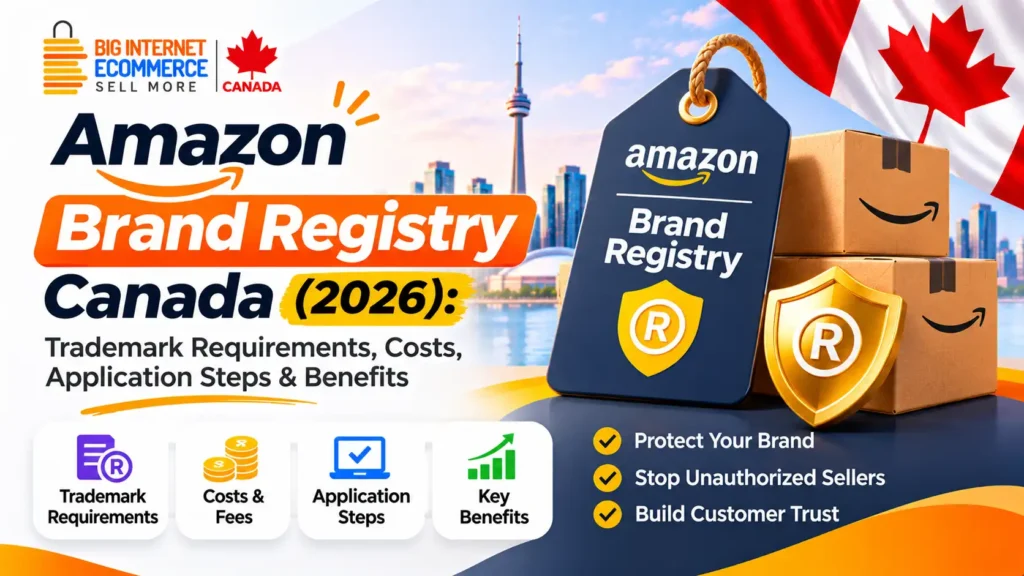
Quick Answer: To enrol in Amazon Brand Registry Canada, your brand generally needs an eligible registered trademark or qualifying pending trademark application from an accepted intellectual property office. The trademark must match the brand being enrolled, and your brand name must be permanently displayed on your product or packaging. You will also need the relevant trademark number, product categories and brand images. Amazon Brand Registry enrolment is free, but trademark filing, legal assistance, product photography and other services can involve separate fees. Once approved, eligible brands can access additional brand protection, A+ Content, Brand Stores, advertising and analytics tools.
Brand Registry help Protect your brand and unlock brand tools.
Get Brand Registry Help →Building an Amazon business involves more than listing a product and running advertisements.
As a brand grows, it becomes increasingly important to establish a recognizable identity, maintain accurate product information and protect legitimate intellectual property rights.
You might have invested in product development, packaging, photography and marketing. But without an organized brand strategy, issues such as inaccurate product pages, unauthorized use of your brand’s intellectual property and inconsistent content can create difficulties.
For Canadian businesses selling on Amazon.ca, Amazon Brand Registry is one of the most important programmes to understand.
It provides eligible rights owners with access to tools intended to help protect their brands and improve their Amazon shopping experience.
However, many sellers are unsure about the requirements.
Do you need a registered Canadian trademark? Can you apply with a pending trademark? Is Brand Registry free? Does a US trademark work for a Canadian seller? What benefits become available after approval?
This guide answers those questions using Amazon’s published programme guidance and the Canadian Intellectual Property Office’s current trademark information.
At Big Internet Ecommerce (BIE), we support Canadian brands through Amazon account management, listing optimization, Amazon SEO, product creative, advertising and brand-related marketplace coordination.
Our Canadian business is based in Maple Ridge, British Columbia, with remote services available to eligible brands across Canada.
Whether you’re launching a new private-label brand, expanding an established ecommerce business or improving an existing Amazon catalogue, this guide will help you understand the Brand Registry process and how it connects to your wider Amazon strategy.
Request an Amazon Brand & Listing Audit
What Is Amazon Brand Registry Canada?
Amazon Brand Registry is a free Amazon programme designed to help eligible brand owners protect their intellectual property and access additional brand-building tools within Amazon’s stores.
The programme is intended for businesses that own or control eligible registered trademarks or qualifying pending applications.
For example, a Canadian company developing its own skincare brand may want to create consistent product pages, use enhanced content and identify suspected trademark infringement.
A manufacturer may want greater control over the accuracy of information associated with its branded products.
A direct-to-consumer business expanding from Shopify to Amazon.ca may want to develop a Brand Store and connect its product listings to a recognizable identity.
Amazon Brand Registry can support those goals when the brand meets the relevant requirements.
What Does Brand Registry Actually Do?
Brand Registry connects an eligible trademark and brand identity with Amazon’s brand-management systems.
Depending on the marketplace, account role and programme eligibility, this can provide access to tools for:
- Reporting suspected intellectual property infringement.
- Monitoring possible misuse of a brand.
- Managing certain brand-related catalogue issues.
- Creating enhanced A+ Content.
- Building an Amazon Brand Store.
- Accessing eligible advertising formats.
- Using available Brand Analytics tools.
- Developing richer product information.
- Managing authorized Brand Registry users.
- Connecting additional trademarks to an enrolled brand.
Not every enrolled brand automatically receives every Amazon programme or feature.
Some capabilities require additional eligibility or have separate conditions.
Is Brand Registry the Same as Selling on Amazon?
No.
Amazon Seller Central is the platform businesses use to manage their third-party selling operations.
Amazon Brand Registry is a separate brand-related programme.
A seller may operate a Seller Central account without owning a registered trademark or enrolling in Brand Registry.
Similarly, a trademark owner can have brand-management requirements that are different from the responsibilities of its authorized sellers.
For the complete seller-account process, read BIE’s How to Sell on Amazon Canada in 2026.
Who Can Apply for Amazon Brand Registry in Canada?
Brand Registry is mainly intended for eligible trademark owners.
This can include Canadian private-label businesses, manufacturers, established consumer brands and other companies with qualifying trademarks.
The key requirement is not simply having a company or selling a product.
The applicant must have the relevant trademark rights and meet Amazon’s enrolment conditions.
Private-Label Amazon Sellers
A private-label seller develops or markets products under its own brand identity.
For example, a Canadian company might source reusable kitchen products and sell them under a registered brand name.
If the company owns an eligible trademark and its products or packaging display the brand correctly, Brand Registry may be appropriate.
Canadian Manufacturers
Manufacturers selling branded goods may also qualify.
Brand Registry can be useful when product specifications, images and brand information need to remain consistent across Amazon listings.
DTC Ecommerce Brands
Businesses already selling through their own websites may consider Brand Registry when expanding to Amazon.ca.
For a Shopify brand, Amazon may become an additional retail channel rather than a replacement for the existing business.
The brand should coordinate its trademark, product data, imagery and selling strategy before launch.
Established Amazon Sellers
An existing seller may decide to enrol after developing its own brand or obtaining a relevant trademark.
Brand Registry can provide additional tools, but approval does not guarantee improved rankings or the removal of other sellers.
Authorized Resellers and Distributors
Reselling authentic products does not automatically make a business the trademark owner.
A distributor or reseller should not apply as the owner of a trademark it does not control.
Where appropriate, the actual rights owner can enrol the brand and grant authorized users suitable access.
Important: Amazon states that the trademark owner should enrol the brand. Authorized agents should be added through the programme’s user and role-management system after enrolment.
Amazon Brand Registry Requirements in 2026
Before beginning the application, confirm that your brand meets the current programme criteria.
Amazon identifies several important requirements.
| Requirement | What you need |
|---|---|
| Eligible trademark | Active registered trademark or qualifying pending application |
| Accepted IP office | Trademark issued or filed through an Amazon-supported trademark office |
| Brand name consistency | Brand Registry name matching the relevant trademark text |
| Trademark identification | Registration or application number |
| Logo | Standalone image of the actual brand logo |
| Product branding | Brand name/logo permanently displayed on products or packaging |
| Product categories | Categories associated with the brand |
| Ownership | Proper authorization from the rights owner |
| Application access | A suitable Brand Registry account and required verification |
These requirements are based on Amazon’s official Canadian Brand Registry guidance.
1. An Eligible Registered or Pending Trademark
Amazon generally requires a qualifying trademark.
The trademark can be a word mark or a supported design mark containing words, letters or numbers.
The exact eligibility of pending applications can depend on the relevant trademark office and Amazon’s current programme rules.
2. Correct Trademark and Brand Name
The brand name entered into the application needs to match the trademark information.
For example, if the registered word mark is “Northstar Living,” applying under a substantially different brand name may create a verification problem.
Don’t assume that differences in wording, spelling or ownership information will be accepted.
Check the official trademark record before applying.
3. Product or Packaging Branding
Amazon requires evidence that the logo containing the brand name is permanently affixed to products or their packaging.
This helps establish a connection between the trademark and the products being enrolled.
The required photographs should show genuine products or packaging.
A digitally inserted logo on a generic mockup is not a reliable substitute for authentic branding evidence.
4. Trademark Application or Registration Number
The Brand Registry application requires the relevant number issued by the accepted trademark office.
Keep this information consistent with the official trademark record.
5. Product Categories
Amazon may ask which product categories are associated with the brand.
Prepare accurate information about the products you intend to sell.
6. Trademark Ownership and Authorization
The appropriate rights owner must manage the enrolment.
If an Amazon marketing agency is helping with the process, the brand owner should retain suitable ownership and administrator control.
The agency can then receive authorized access according to the agreed work.
Official guidance: Amazon Brand Registry Canada.
Can You Enrol in Amazon Brand Registry With a Pending Trademark?
Yes, Amazon accepts certain pending trademark applications, subject to current eligibility rules and the trademark office involved.
This is particularly relevant for Canadian businesses preparing to launch a new brand.
A trademark registration can take time.
Businesses may want to begin preparing their Amazon product pages and brand assets while the application is still being processed.
However, a pending application does not guarantee approval.
Registered Trademark vs Pending Trademark
| Status | Meaning | Brand Registry consideration |
|---|---|---|
| Registered trademark | The relevant IP office has granted trademark registration | Generally eligible when all Amazon conditions are met |
| Pending application | An application has been filed but registration is not complete | May qualify under Amazon’s accepted pending-mark rules |
| Unfiled brand name | A business is using a name but has not filed an eligible trademark | Does not by itself satisfy the trademark requirement |
| Business registration only | The company has a registered business name | Not a substitute for an eligible trademark |
| Domain name ownership | The business owns a website domain | Does not establish Brand Registry trademark eligibility |
| Copyright registration | Protects qualifying creative works | Not a replacement for the trademark requirement |
Can You Use Any Pending Application?
No.
Amazon’s public guidance allows pending trademarks under specific conditions.
The accepted offices, filing routes and verification requirements can change.
Before relying on a pending application, review the current requirements for the relevant IP office.
What Happens When Your Pending Trademark Is Registered?
After a pending application becomes registered, the brand may need to update its intellectual property information in Brand Registry.
Amazon provides a Manage Intellectual Property workflow for connecting and managing trademarks.
Keeping trademark status current can help prevent avoidable brand-account issues.
Does Brand Registry Approval Mean Your Trademark Will Be Registered?
No.
Amazon Brand Registry and trademark registration are separate processes.
Amazon cannot guarantee that CIPO, the USPTO or another trademark office will approve an application.
Trademark registration remains subject to the relevant legal process.
Canadian Trademark vs US Trademark: Which Do You Need?
Canadian businesses often ask whether a Canadian trademark is necessary to sell on Amazon.ca or whether a US trademark can be used.
The answer depends on what the business is trying to accomplish.
For Amazon Brand Registry Enrolment
Amazon accepts trademarks issued by designated intellectual property offices and operates a global Brand Registry account system.
It is not always necessary to create a separate Brand Registry account for each country.
Amazon also recommends connecting trademarks relevant to the countries in which the brand operates.
For Legal Trademark Protection
Trademark protection is generally territorial.
A trademark registered in Canada does not automatically provide identical legal rights throughout the United States.
Likewise, a US trademark is not a substitute for evaluating Canadian trademark protection.
The appropriate filing strategy depends on the countries where the business intends to operate and protect its brand.
For Canadian Brands Expanding to Amazon.com
A Canadian brand planning US expansion should consider whether it needs additional US trademark protection, product compliance review and marketplace preparation.
A qualified Canadian trademark agent or IP lawyer can help determine the correct approach.
Practical Comparison
| Question | Canadian trademark | US trademark |
|---|---|---|
| Issuing office | Canadian Intellectual Property Office | United States Patent and Trademark Office |
| Main legal jurisdiction | Canada | United States |
| Relevant to Amazon Brand Registry | Yes, subject to eligibility | Yes, subject to eligibility |
| Trademark protection in the other country | Not automatic | Not automatic |
| Appropriate for cross-border businesses | Depends on market and IP strategy | Depends on market and IP strategy |
Do not file in a particular country solely because a website claims it guarantees faster Amazon approval.
Consider the actual commercial and legal needs of the brand.
How Much Does Amazon Brand Registry Cost in Canada in 2026?
Amazon Brand Registry enrolment itself is free. The expenses usually arise from trademark filing, legal services, optional creative work, selling fees and advertising.
These costs should be kept separate.
Official Canadian Trademark Filing Fees for 2026
The Canadian Intellectual Property Office (CIPO) publishes government trademark filing fees.
For an application filed online through CIPO in 2026:
| Trademark application charge | 2026 government fee |
|---|---|
| First class of goods or services | CAD $491.06 |
| Each additional class | CAD $149.04 |
| Filing by other permitted means, first class | CAD $640.10 |
These are official filing fees, not BIE’s service prices or a lawyer’s professional fees.
A trademark covering several classes can cost more than an application covering one class.
Other costs may arise depending on the application and future actions.
The latest government fee schedule should be checked before paying.
Source: CIPO — Fees for Trademarks.
What Are Trademark Classes?
Trademark applications identify the goods and services associated with the mark.
These goods and services are organized using the relevant classification system.
For example, a brand selling cosmetics and providing unrelated professional services may need to consider different classes.
The correct classification should reflect the business’s actual goods and services.
Filing for unnecessary classes can increase costs.
Failing to consider relevant goods and services can also create problems.
A qualified trademark professional can help assess the appropriate application.
Other Potential Expenses
Trademark agent or lawyer: Professional research, application preparation and legal advice.
Trademark search: Reviewing potentially conflicting marks before filing.
Product packaging: Creating packaging that accurately displays the brand.
Photography: Preparing genuine product and packaging images.
Amazon account services: Listing setup, catalogue work, product images or account management.
A+ Content design: Professional creative services, if outsourced.
Advertising: Paid Amazon campaigns.
Cost Comparison
| Expense | Charged by | Mandatory for every brand? |
|---|---|---|
| Brand Registry enrolment | Amazon | No programme enrolment fee |
| Trademark government filing | Relevant trademark office | Relevant when filing a new trademark |
| Legal representation | Trademark agent or lawyer | Depends on circumstances |
| Product and packaging photography | Creative provider | Images are required; outsourced photography is optional |
| Amazon A+ Content creation tool | Amazon | Available without separate tool fees to eligible users |
| Agency A+ Content design | Agency | Optional |
| Amazon PPC advertising | Amazon Ads | Optional |
| Amazon selling fees | Amazon | Depend on seller plan and transactions |
How Much Should a Canadian Brand Budget?
Start with the verified trademark filing costs and any professional assistance required.
Then estimate the work needed to prepare real packaging, correct listings and useful brand content.
Do not confuse trademark registration costs with Amazon selling-plan costs.
For a broader comparison of marketplace expenses, read BIE’s How to Sell on Amazon Canada Guide and Amazon FBA Canada Fees & Profitability Guide.
How to Register a Trademark in Canada Before Applying for Brand Registry
Canadian businesses without an eligible trademark may need to begin with the Canadian Intellectual Property Office.
This is a legal process distinct from Amazon account management.
Step 1 — Decide Which Brand Name You Want to Protect
Start by identifying the name or mark used with your products.
Consider whether the proposed mark is distinctive and suitable for trademark registration.
Do not assume that registering a corporation with a particular business name automatically creates trademark eligibility.
Step 2 — Search for Potentially Conflicting Trademarks
A preliminary search can identify existing marks that may be relevant.
However, trademark clearance can involve legal considerations beyond searching for an identical name.
A trademark professional may be able to identify potential conflicts and filing risks.
Step 3 — Determine the Appropriate Goods and Services
The application needs to describe the goods and services associated with the trademark.
Prepare accurate descriptions and identify the appropriate classes.
Step 4 — Prepare the Application
The relevant business information and trademark details should be complete and consistent.
If a trademark agent is representing the business, confirm the professional’s authorization.
Step 5 — File Through CIPO
CIPO offers an online filing service.
The government filing fee depends on the application and the number of classes.
Official resource: CIPO — File a Trademark Application.
Step 6 — Retain Your Application Details
Keep your official filing receipt and application number.
These details may be needed when checking Brand Registry eligibility.
Step 7 — Monitor the Application
Trademark applications may require examination, correspondence, corrections or other actions.
CIPO’s current service standard targets an initial action within 14 months for qualifying national applications, but that is not a promise of completed registration.
Application circumstances vary.
Step 8 — Consider Amazon Enrolment Eligibility
If your application is pending, review Amazon’s current rules to determine whether the specific application qualifies for Brand Registry.
Do not assume that all pending applications are accepted.
Amazon Brand Registry Application Process: Step-by-Step Guide
Once the trademark and brand information are ready, you can begin the Amazon enrolment process.
Step 1 — Visit the Official Amazon Brand Registry Portal
Go to:
https://brandregistry.amazon.ca/
Use the legitimate Amazon enrolment interface.
Avoid websites requesting payment for supposedly mandatory Amazon Brand Registry activation.
Step 2 — Use the Appropriate Amazon Account
Amazon recommends using credentials that can connect Brand Registry with the relevant selling account where applicable.
Keep account ownership with the actual business and authorized rights owner.
Step 3 — Start a New Brand Enrolment
Select the option to enrol a brand.
Review the current application instructions.
Step 4 — Enter the Brand Name
Enter the brand name so it matches the official trademark information.
Pay attention to the exact mark text.
Step 5 — Choose the Trademark Office
Select the relevant accepted trademark office.
For a CIPO application, use the appropriate Canadian trademark information.
Step 6 — Enter the Trademark Number
Provide the official registration or application number.
Check that it matches the relevant record.
Step 7 — Upload the Brand Logo
Use the actual brand logo corresponding to the application.
For a design mark, Amazon may require an image consistent with the registered or pending trademark.
Step 8 — Upload Product or Packaging Images
Provide genuine images showing the brand name/logo permanently displayed on products or packaging.
The photos should make the branding clear.
Do not rely on an artificial mockup that fails to demonstrate authentic branding.
Step 9 — Provide Product Category Information
Select or enter the relevant product categories required by the application.
Make sure the categories relate to the actual products being enrolled.
Step 10 — Complete the Verification Process
Amazon may verify trademark ownership and other information.
Follow the instructions presented in the current portal.
Depending on the situation, Amazon may contact the rights owner or require additional verification.
Step 11 — Submit the Application
Check the details carefully before submitting.
Avoid submitting conflicting information or repeated duplicate applications without a reason.
Step 12 — Track the Application Status
Amazon provides a Brand Applications area where applicants can review their application status and relevant messages.
If additional information is requested, respond through the official process.
Step 13 — Address Any Rejection
If an application is rejected, review the actual reason.
Correct the relevant error and follow Amazon’s provided process rather than immediately creating another brand identity.
Step 14 — Set Up Authorized Users After Approval
Once the brand is enrolled, the rights owner can assign appropriate roles to employees or service providers.
Do not share the primary account password with external agencies.
Request an Amazon Brand & Listing Review
Amazon IP Accelerator Canada: What Is It and Who Should Consider It?
Amazon IP Accelerator is a programme that connects businesses with participating intellectual property legal service providers.
It is designed to help eligible brands access trademark-related services and potentially gain earlier access to some Brand Registry benefits.
Does Amazon IP Accelerator Register the Trademark?
Amazon connects businesses with participating legal service providers.
The actual legal work and filing are performed through the appropriate professional and trademark office.
Amazon does not guarantee trademark registration.
Is IP Accelerator Free?
Amazon does not charge a fee merely to connect you with participating legal service providers.
However, businesses pay the selected professionals for the services they provide.
Official trademark fees and other relevant costs may also apply.
Can IP Accelerator Help With a Pending Trademark?
Amazon explains that participating businesses may access certain Brand Registry benefits while trademark registration is pending.
The actual requirements depend on the programme and the relevant trademark office.
Who Should Consider IP Accelerator?
It may be relevant for businesses that need professional trademark assistance and want to understand their available Amazon enrolment options.
However, an independent qualified trademark professional may also be an appropriate choice.
Compare the services, qualifications, fees and filing strategy before committing.
Official resource: Amazon IP Accelerator Canada.
What Happens After Your Amazon Brand Registry Application Is Approved?
Approval is the beginning of a brand-management process, not the end of the work.
After enrolment, businesses should review which features and permissions are actually available.
Confirm Brand Ownership Information
Ensure that the correct rights owner and authorized users have access.
Review Product Listings
Check whether existing products display the correct brand information.
Investigate inconsistent brand names, inaccurate attributes or listing issues.
Evaluate A+ Content Opportunities
Identify products that may benefit from enhanced explanations, comparisons or visuals.
Review Brand Store Eligibility
Eligible brands can use Amazon’s Brand Store functionality to present a more organized brand experience.
Explore Brand Analytics
Review which brand-related reporting tools are available to the account.
Coordinate Amazon Advertising
Eligible advertising formats can support brand and product discovery.
Advertising should be planned around product availability and commercial objectives.
Establish Brand Protection Monitoring
Use appropriate tools to review suspected trademark misuse or other genuine IP issues.
Do not misuse infringement reporting to eliminate legitimate competition.
Maintain Current Trademark Records
Keep relevant intellectual property information accurate as applications progress or trademarks are renewed.
10 Important Benefits of Amazon Brand Registry for Canadian Sellers
Brand Registry can provide access to useful tools, but the benefits depend on the account and product programme.
1. Additional Brand Protection Tools
Amazon offers mechanisms to identify and report suspected intellectual property infringement.
These can help legitimate rights owners investigate potentially unauthorized use of protected marks.
2. Report a Violation
Eligible rights owners can access tools for reporting suspected IP violations.
Reports should be based on actual rights and evidence.
3. More Brand-Related Listing Management Tools
Enrolled brands may gain access to additional tools for managing certain brand-related content.
However, Brand Registry does not guarantee unlimited control over every Amazon catalogue contribution.
4. Amazon A+ Content
Eligible brands can create enhanced product information using images, text, comparisons and other supported elements.
A+ Content can make technical or feature-rich products easier to understand.
5. Amazon Brand Store
A Brand Store allows eligible businesses to organize their brand presentation within Amazon.
A well-planned Store can help customers explore different product collections.
6. Sponsored Brands Advertising
Eligible brands may access advertising formats designed to support brand and product discovery.
The ad spend is separate from Brand Registry enrolment.
7. Brand Analytics
Amazon’s available brand analytics tools may help businesses understand relevant shopping and product-performance information.
Feature availability depends on account eligibility.
8. Customer Product Education
Enhanced brand content can help explain product features, materials, use cases and comparisons.
The content still needs to be accurate and consistent with Amazon policy.
9. A More Consistent Brand Experience
Brand-owned content and creative can help customers recognize the brand across different ASINs.
10. Access to Additional Eligible Programmes
Some brand-related tools, such as certain protection and customer-engagement programmes, have their own eligibility requirements.
Brand Registry is often an important foundation, but not automatic approval for every programme.
Amazon Brand Registry vs Amazon Seller Central: Key Differences
Amazon Brand Registry and Seller Central serve different purposes.
| Feature | Seller Central | Brand Registry |
|---|---|---|
| Primary purpose | Third-party selling operations | Brand identity, protection and brand-related tools |
| Trademark required | Not universally required for opening an account | Eligible trademark generally required |
| Product listings | Create or manage authorized offers and listings | Additional brand-related content capabilities |
| Orders and fulfilment | Yes, according to selling model | Not the primary purpose |
| Amazon advertising | Available to eligible sellers | Can support eligibility for additional brand formats |
| Brand protection | General seller reporting and policy tools | Additional rights-owner tools |
| A+ Content | Availability depends on eligibility | Brand Registry is an important qualification route |
| Brand Store | Available to eligible brands | Helps support access to eligible brand features |
| Financial reporting | Seller operations and settlement data | Not a replacement for seller financial records |
A business may need both an organized Seller Central operation and an appropriate Brand Registry setup.
For continuing operational support, explore Amazon Account Management Services Canada.
Get guidance on eligibility, A+ Content and brand protection for Amazon.ca.
- Check your trademark and eligibility readiness
- Plan A+ Content and brand tools
- No Amazon password needed to enquire
How Amazon Brand Registry Supports Amazon SEO and Product Visibility
Brand Registry does not automatically improve organic rankings.
However, certain tools available to eligible brands can support the quality and relevance of product information.
Accurate Product Information
A product listing should contain accurate titles, bullets, attributes and descriptions.
Brand Registry can help create a stronger framework for managing relevant brand content.
Consistent Brand Identity
Correct brand information may help shoppers recognize the business across products.
Keyword-Relevant Product Content
Amazon SEO still requires understanding customer search terms and the product’s actual features.
Avoid inserting irrelevant keywords simply because they have high search volume.
Image and Content Quality
Product images and enhanced information can help customers evaluate a product.
Product Discoverability vs Conversion
Search relevance and the customer experience are related, but they are not identical.
Brand Registry is not a substitute for effective Amazon SEO.
For specialist content optimization, see BIE’s Amazon SEO Services Canada.
Brands researching related seller guidance can also review the BIE Amazon Seller Blog.
Amazon Brand Registry and A+ Content: What Should Brands Create?
A+ Content is one of the most visible tools associated with eligible brand programmes.
It provides additional space to explain products through supported enhanced content.
Basic A+ Content
Basic A+ can include text, images and comparison modules.
For example, a kitchenware brand might use it to explain materials, dimensions and cleaning instructions.
Premium A+ Content
Premium A+ offers additional content capabilities for eligible accounts.
Availability depends on Amazon’s current eligibility requirements.
Amazon Brand Story
Brand Story helps introduce the brand and connect relevant products through supported content formats.
What Makes Effective A+ Content?
A useful A+ experience should answer real customer questions.
It should not simply repeat the same product slogan across several image modules.
Useful content may explain:
- Important product features.
- Materials and specifications.
- Instructions or intended use.
- Product variants.
- Appropriate comparisons.
- The brand’s actual identity.
- Product information customers commonly misunderstand.
Does Brand Registry Guarantee Better Conversions?
No.
Amazon describes potential benefits from well-implemented enhanced content, but individual results vary.
It is not appropriate to promise a specific conversion increase for every product.
For professional content services, explore Amazon A+ Content Design Canada.
You can also examine genuine creative projects such as Dreamscape Kids and Cubby Couch to understand how BIE presents product information visually.
How Brand Registry Connects With Amazon PPC and Brand Advertising
Brand Registry is an important consideration when planning a more complete Amazon marketing strategy.
Eligible brands may be able to use Sponsored Brands and other brand-oriented advertising features.
Sponsored Products
Sponsored Products promote eligible individual listings.
Brand Registry is not universally required for sellers to use this advertising format.
Sponsored Brands
Sponsored Brands can support brand discovery through relevant placements and creative formats.
Eligibility requirements should be checked in the advertising account.
Brand Store Advertising
An eligible Brand Store can provide a destination for certain brand campaigns.
A useful Store needs clear navigation and relevant product information.
Advertising and A+ Content
Advertising may bring shoppers to a product page.
The listing and A+ Content need to communicate enough information for the shopper to evaluate the product.
Poor content won’t automatically improve because advertising spend increases.
Amazon.ca vs Amazon.com Campaigns
Canadian brands operating across marketplaces should review their advertising performance separately.
Competition, search behaviour, product availability and currency can differ.
For a practical explanation of campaign management, read BIE’s Amazon PPC Agency Canada Guide and Amazon PPC Management Canada.
Common Amazon Brand Registry Application Errors and How to Fix Them
Even businesses with genuine trademarks can encounter enrolment problems.
A rejection doesn’t always mean the brand is permanently ineligible.
The correct response depends on the exact error.
| Application issue | Possible explanation | Next step |
|---|---|---|
| Trademark number rejected | Incorrect number or unsupported record | Compare with official IP office records |
| Brand name mismatch | Application name differs from mark text | Correct the matching information |
| Trademark owner mismatch | Wrong applicant or ownership details | Confirm rights-owner information |
| Logo mismatch | Uploaded logo differs from relevant trademark | Use accurate brand artwork |
| Packaging evidence rejected | Brand not clearly or permanently displayed | Provide genuine compliant product/packaging images |
| Pending mark not accepted | Filing does not meet current eligibility route | Check office-specific pending-mark rules |
| Brand already enrolled | Existing Brand Registry relationship | Use the current access or ownership process |
| Verification incomplete | Required confirmation not completed | Follow the official verification instructions |
| Product categories inconsistent | Brand/product information needs clarification | Review the category details |
| Application remains pending | Amazon may need further review | Monitor the official application status |
Mistake 1 — Assuming a Business Name Is a Trademark
A registered company name and a registered trademark are not the same thing.
Ensure that the application meets Amazon’s actual trademark requirements.
Mistake 2 — Applying Under the Wrong Owner
The trademark owner should control the Brand Registry enrolment.
Agencies or contractors should receive suitable authorized roles.
Mistake 3 — Using Product Images With Digitally Added Branding
Amazon requires appropriate product or packaging evidence.
Use genuine images that meet the stated requirements.
Mistake 4 — Submitting Incorrect Trademark Details
Even small differences can create verification problems.
Compare the application with official trademark records.
Mistake 5 — Assuming All Pending Trademarks Qualify
Eligibility may depend on the trademark office and application route.
Check current requirements before submitting.
Mistake 6 — Creating Duplicate Enrolment Applications
If the brand is already enrolled, use the appropriate existing-brand, access or ownership workflow.
Mistake 7 — Expecting Automatic Catalogue Ownership
Brand Registry can provide additional capabilities, but Amazon retains its catalogue and policy controls.
Mistake 8 — Treating Brand Registry as a Guarantee Against Counterfeits
Brand protection tools can support enforcement, but they cannot guarantee that every infringement will be prevented.
Amazon Brand Registry and Unauthorized Sellers: What Can You Actually Do?
A common misunderstanding is that Brand Registry allows a brand to remove every other business selling its products.
That is not how trademark rights or Amazon’s marketplace necessarily work.
Unauthorized Seller vs Trademark Infringement
A business may sell a genuine product without necessarily infringing the trademark owner’s rights.
Whether a particular offer infringes intellectual property rights depends on the facts and applicable law.
What Can Brand Owners Report?
Amazon provides tools for reporting suspected IP infringement.
A report should identify the relevant right and the suspected violation.
Examples may involve counterfeit products or unauthorized use of protected creative or marks.
What Brand Registry Does Not Guarantee
Brand Registry does not create a universal right to eliminate all competing offers.
It does not guarantee exclusive possession of a product detail page.
It does not override every legitimate resale right.
How Should a Brand Respond?
Document the suspected issue.
Review the relevant intellectual property right.
Gather legitimate supporting evidence.
Use Amazon’s appropriate reporting process.
Seek professional legal advice when the situation requires it.
Avoid submitting false or unsupported infringement complaints.
Amazon Brand Registry Services Across Canada: Vancouver, Toronto, Montreal, Calgary and More
Canadian brands operate in different provinces and industries, but the core Brand Registry programme is based on Amazon’s eligibility rules rather than the city where a business is located.
The most relevant local differences usually involve product categories, target markets, language, logistics and the company’s legal or commercial circumstances.
Amazon Brand Registry Vancouver and British Columbia
Businesses in Vancouver, Surrey, Burnaby, Richmond, Coquitlam and Maple Ridge may use Amazon.ca as an additional sales channel.
A Vancouver-based private-label brand might need trademark preparation, brand content and Amazon listing optimization before launching advertising.
BIE’s Canadian operations are based in Maple Ridge, British Columbia.
We support eligible businesses remotely across Metro Vancouver and the rest of BC.
Amazon Brand Registry Toronto and Ontario
Brands in Toronto, Mississauga, Brampton, Markham, Vaughan, Hamilton and Ottawa may be developing Canadian marketplace strategies or expanding into Amazon.com.
Trademark ownership, account setup, product content and marketplace readiness remain important.
A brand selling across Canada and the United States should evaluate each marketplace’s operational and legal requirements separately.
Amazon Brand Registry Montreal and Quebec
Businesses in Montreal, Laval, Quebec City and other Quebec locations may need to consider French-language requirements alongside Amazon brand content.
The applicable legal obligations depend on the product, packaging and business activities.
Brand Registry approval does not replace relevant consumer-information or language compliance obligations.
Amazon Brand Registry Calgary and Alberta
Businesses in Calgary, Edmonton and other Alberta markets may use Amazon.ca to reach customers outside their immediate region.
Brand Registry can be part of a broader plan involving trademark ownership, consistent listings and product advertising.
Amazon Brand Registry Ottawa and Eastern Canada
Brands in Ottawa and across Atlantic Canada may also consider Amazon.ca for national selling.
Marketplace eligibility is not dependent on operating from a major Canadian city.
Canada-Wide Service Coverage
BIE supports eligible clients remotely across British Columbia, Ontario, Quebec, Alberta, Manitoba, Saskatchewan, Nova Scotia, New Brunswick, Newfoundland and Labrador, Prince Edward Island and other Canadian regions.
BIE does not claim physical offices in each of these locations. Its Canadian base is in Maple Ridge, British Columbia.
For support across Amazon SEO, creative, listing optimization and account operations, visit Big Internet Ecommerce Canada.
Can Canadian Brands Use Brand Registry for Amazon.com?
Yes, eligible Canadian brands can use Amazon’s global Brand Registry framework when expanding into other Amazon marketplaces.
However, brand enrolment, marketplace selling eligibility and legal trademark protection are different considerations.
One Brand Registry Account vs Multiple Seller Accounts
Amazon states that a single global Brand Registry account can be used to manage enrolled brands and connect relevant trademarks.
But a business’s Seller Central marketplace arrangements are separate operational matters.
US Marketplace Preparation
Before selling on Amazon.com, consider product compliance, account access, listing content, fulfilment, advertising and relevant legal responsibilities.
Protecting the Trademark in the US
A Canadian trademark does not automatically provide complete US trademark protection.
A trademark professional can help assess the appropriate protection strategy.
Advertising and Listing Localization
US search behaviour, competition and product economics may differ from Canada.
The brand may need separate keyword research, advertising and content planning.
For more on cross-marketplace strategy, read Best Amazon Services in Canada: Top Agencies, Pricing & Seller Guide.
When Should You Hire an Amazon Brand Management Agency?
Not every brand needs to outsource Brand Registry enrolment.
Some businesses can complete the process themselves when their trademark and product information are straightforward.
Professional support becomes more relevant when the brand needs help coordinating several connected activities.
You Are Launching a New Private-Label Brand
You may need product catalogue preparation, brand images, A+ Content and an advertising launch strategy.
Your Listings Have Incorrect Brand Information
Catalogue corrections can require careful investigation and appropriate account permissions.
Your Product Images Need Improvement
A professional creative team can prepare accurate product imagery and enhanced content.
You Need Amazon SEO
Brand Registry doesn’t replace keyword research and product relevance.
A specialist may help improve the usefulness and search coverage of eligible listings.
Your Account Has Recurring Operational Issues
Seller Central account management can help coordinate catalogue tasks and support cases.
You Want a Brand Store
An eligible Brand Store requires a suitable product structure and useful brand creative.
You Are Expanding Across Amazon Marketplaces
A coordinated approach can help maintain consistent brand information while addressing marketplace-specific differences.
What Should the Agency Actually Do?
Before engaging a provider, clarify whether the service includes:
- Marketplace readiness assessment.
- Brand Registry application coordination.
- Trademark information review.
- Listing and catalogue preparation.
- Product-image creation.
- A+ Content design.
- Brand Story development.
- Amazon Brand Store design.
- Seller Central support.
- Advertising planning.
- Ongoing reporting.
An Amazon marketing agency should not present itself as a trademark law firm unless it actually has the appropriate professional authorization.
Want an expert to apply this to your account? Request a review and get clear next steps.
Get Brand Registry Help →How BIE Supports Brand Owners on Amazon Canada
At Big Internet Ecommerce, our work connects several parts of Amazon marketplace management.
Brand Registry is relevant because brand identity, product content and account operations often overlap.
Amazon Brand and Account Setup Coordination
BIE can discuss eligible brand-related account workflows and the marketplace preparation needed before or after enrolment.
Legal trademark services must be performed by appropriately qualified professionals.
Amazon Product Listing Optimization
We work on clearer product titles, bullet points, attributes, descriptions and imagery according to the account’s needs.
Explore Amazon Listing Optimization Services Canada.
Amazon A+ Content and Brand Story
Our creative services can include product education, comparison modules and brand-oriented enhanced content.
Explore Amazon A+ Content Services.
Amazon SEO and Keyword Research
We help brands research relevant shopper language and improve product discoverability through accurate content.
Explore Amazon SEO Services Canada.
Amazon PPC Advertising
Eligible brands may need advertising support after the products and account are ready.
Explore Amazon PPC Management.
Seller Central Management
We help coordinate catalogue, account-health and other operational tasks within the agreed service scope.
Explore Amazon Account Management Canada.
Real Example: Econocraft Materials
BIE’s published Econocraft Materials case study documents work involving seller account registration, product-identification setup, trademark-filing and Brand Registry enrolment coordination, listing content, creative assets and advertising.
This is a real example of connected brand setup and marketplace work.
The project relates to Amazon.com in the United States, not a verified Canadian trademark-registration outcome.
It should not be presented as evidence that BIE guarantees Brand Registry approval or provides legal representation.
Explore the Econocraft Materials Case Study.
Our Approach
We begin by understanding the brand, products, existing account and current marketplace challenges.
The work may include reviewing brand presentation, identifying relevant content needs and coordinating the agreed marketplace tasks.
We do not guarantee trademark registration, Brand Registry approval, ranking improvements or sales outcomes.
Request Your Amazon Brand & Listing Audit
Amazon Brand Registry Preparation Checklist
Before applying, review this checklist.
| Preparation item | Status to confirm |
|---|---|
| Brand name | Matches official trademark information |
| Trademark | Registered or eligible pending application |
| Trademark office | Accepted under Amazon’s current requirements |
| Trademark number | Correct official application or registration number |
| Trademark owner | Authorized rights owner identified |
| Logo | Genuine and accurate standalone image |
| Product or packaging branding | Permanently displayed and properly photographed |
| Product categories | Relevant to the branded products |
| Seller account | Correct ownership and access permissions |
| Application email | Controlled by the appropriate business representative |
| Product information | Accurate titles, descriptions and attributes |
| Product images | Compliant and approved |
| Account plan | Suitable for intended marketplace activities |
| Brand Store plan | Prepared if relevant and eligible |
| A+ Content plan | Prepared according to product needs |
| Advertising plan | Based on product readiness and budget |
| Trademark legal advice | Obtained where necessary |
| Brand Registry access | Authorized users and roles defined |
A checklist cannot guarantee approval, but it can help reduce avoidable application errors.
Frequently Asked Questions About Amazon Brand Registry Canada
1. What is Amazon Brand Registry Canada?
Amazon Brand Registry is a free Amazon programme for eligible trademark owners.
It provides access to brand-protection and brand-building tools, subject to applicable programme requirements.
2. Is Amazon Brand Registry free in Canada?
Yes. Amazon does not charge a separate enrolment fee for Brand Registry.
Trademark filing, legal services, creative production, Amazon selling and advertising may involve other costs.
3. Do I need a trademark for Amazon Brand Registry?
Yes. Amazon generally requires an eligible registered trademark or qualifying pending trademark application.
A business name or domain name alone is not sufficient.
4. Can I enrol with a pending Canadian trademark?
Certain pending trademarks may qualify under Amazon’s current eligibility rules.
Confirm the specific accepted office and application conditions before relying on a pending filing.
5. How much does a Canadian trademark cost in 2026?
CIPO’s 2026 online application fee is CAD $491.06 for the first class and CAD $149.04 for each additional class.
Legal and other professional costs are separate.
6. Does Amazon accept CIPO trademarks?
Yes. Canadian Intellectual Property Office trademarks are among the eligible trademark sources under Amazon’s Brand Registry programme, subject to current conditions.
7. Can I use a US trademark for Amazon Brand Registry Canada?
Amazon supports trademarks issued by designated accepted intellectual property offices, including the USPTO.
However, the specific eligibility of a pending application and territorial legal protection should be checked separately.
8. Does my brand name need to match the trademark?
Yes. Amazon requires the brand name in the enrolment application to match the relevant trademark text.
Inconsistent information can create verification problems.
9. What product photos are needed?
Amazon requires genuine evidence of your brand name/logo permanently displayed on products or packaging, along with the relevant logo image.
Follow the current application instructions.
10. Can I use a temporary sticker as proof?
Don’t assume a temporary or removable sticker meets Amazon’s requirement for permanently affixed branding.
Use authentic evidence that complies with the current programme criteria.
11. Can a reseller apply for Brand Registry?
An authorized reseller is not automatically the trademark owner.
The relevant rights owner should enrol the brand and can provide authorized user access where appropriate.
12. Do I need Seller Central to use Brand Registry?
Brand Registry and Seller Central have different purposes.
An eligible brand owner can have brand-management needs even where its selling arrangements differ.
Check the current account and role requirements.
13. Can Brand Registry help me remove counterfeit listings?
Brand Registry provides tools for reporting suspected intellectual property infringement.
Amazon reviews relevant reports and makes decisions under its policies.
Not every report results in removal.
14. Can Brand Registry remove every unauthorized seller?
No.
The ability to report a seller depends on actual legal rights and the specific conduct.
Selling authentic goods is not automatically a trademark violation.
15. Does Brand Registry improve Amazon SEO rankings?
It does not guarantee improved rankings.
Some tools can support richer content and better brand presentation, but search results depend on multiple marketplace factors.
16. Does Brand Registry include A+ Content?
Eligible enrolled brands can access A+ Content tools, subject to applicable account and programme requirements.
17. Is Premium A+ Content automatically available?
No. Premium A+ has additional eligibility conditions.
Check your current A+ Content Manager and Amazon’s latest rules.
18. Can I create an Amazon Brand Store after approval?
Eligible brands can create a Brand Store using Amazon’s supported tools.
Availability depends on current account requirements.
19. Can Brand Registry help with Sponsored Brands advertising?
Brand-related advertising formats have eligibility requirements.
Brand Registry can be relevant, but enrolment does not guarantee access to every ad format.
20. Does Brand Registry include Amazon PPC management?
No.
Brand Registry is a programme providing brand tools.
PPC management is a separate advertising activity that a brand can perform internally or outsource.
21. What is Amazon IP Accelerator?
Amazon IP Accelerator connects eligible businesses with participating intellectual property legal service providers.
It can help brands obtain professional trademark services and potentially access Brand Registry benefits sooner.
22. Is IP Accelerator the same as trademark registration?
No.
Trademark registration is handled through the relevant intellectual property office.
IP Accelerator helps connect businesses with participating professionals.
23. How long does Amazon Brand Registry approval take?
Timing depends on the application, trademark information and Amazon’s verification process.
Do not rely on a universal guaranteed approval timeline.
24. How long does Canadian trademark registration take?
Trademark registration can take considerably longer than filing an application.
CIPO’s current first-action service standard is not a guarantee of final registration within that period.
25. What if my Brand Registry application is rejected?
Review the actual rejection reason.
Check the trademark number, brand name, ownership, logo, product evidence and eligibility.
Then follow Amazon’s official correction or support process.
26. Can I enrol multiple brands?
Amazon allows eligible users to enrol additional brands through Brand Registry.
Each brand must meet the relevant requirements.
27. Can I connect multiple trademarks to one brand?
Amazon provides a Manage Intellectual Property process for connecting additional trademarks to an enrolled brand.
28. Does Brand Registry work across Amazon.ca and Amazon.com?
Amazon uses a global Brand Registry account framework.
Businesses may connect relevant trademarks and manage applicable brand tools across supported stores.
Marketplace selling and legal trademark protection still require separate consideration.
29. Can BIE help businesses in Toronto and Vancouver?
Yes. BIE supports eligible brands remotely across Canada from its Maple Ridge, British Columbia base.
That includes Vancouver, Toronto and other Canadian locations.
30. Can BIE help with brand listings and A+ Content?
Yes. BIE offers Amazon listing optimization, A+ Content design, creative, SEO, PPC and account-management services.
The exact responsibilities are defined by the engagement.
31. Does BIE provide legal trademark services?
BIE is an Amazon growth agency, not a substitute for a qualified trademark lawyer or agent.
It can discuss relevant marketplace coordination and work with the client’s appropriate legal professionals.
32. Should a brand register before launching on Amazon Canada?
The right timing depends on the brand’s commercial and legal strategy.
Brand Registry can provide useful tools, but a business should also consider product readiness, trademark protection, fulfilment and selling requirements.
33. Can I sell on Amazon.ca without Brand Registry?
Yes, eligible third-party sellers can sell without Brand Registry, subject to Amazon’s account, category, product and policy requirements.
Brand Registry is a distinct programme.
34. How do I check my Brand Registry application status?
Use Amazon’s official Brand Registry portal and Brand Applications area.
Follow any verification or additional-information requests.
35. How can I get help preparing my Amazon brand for growth?
You can discuss brand-related marketplace preparation, listing quality, product creative and advertising with BIE.
Request an Amazon Growth Audit or contact the BIE Canada team.
Conclusion: Brand Registry Is a Starting Point for Stronger Amazon Brand Management
Building a recognizable Amazon brand takes more than a logo and a product listing.
A business needs legitimate trademark rights, accurate product information, consistent branding and a clear understanding of the marketplace.
Amazon Brand Registry Canada can provide valuable tools for eligible rights owners.
It may help businesses protect intellectual property, create richer product content, build a Brand Store and access additional brand-related features.
But it does not automatically improve rankings, prevent every infringement or guarantee sales.
The strongest approach is to connect Brand Registry with practical Amazon operations.
That means keeping the catalogue accurate, preparing useful product images, understanding customer search behaviour and using advertising according to the brand’s actual goals.
At Big Internet Ecommerce, we help Canadian sellers coordinate these connected marketplace activities.
Whether you are preparing a new private-label brand, improving your existing Amazon presence or exploring cross-border growth, our team can help discuss the relevant account and content priorities.
Request Your Amazon Brand & Listing Audit
Contact Big Internet Ecommerce Canada
Brand Registry eligibility, trademark rules and marketplace features may change. This article provides general educational information and is not legal advice. Trademark registration, Amazon programme approval, product rankings and sales outcomes cannot be guaranteed.
About Big Internet Ecommerce
Big Internet Ecommerce (BIE) is an Amazon growth agency based in Maple Ridge, British Columbia, Canada.
We support eligible Canadian brands with Amazon PPC management, Amazon SEO, listing optimization, A+ Content, Seller Central account management and Vendor Central-related marketplace services.
Our team works with Canadian DTC brands, manufacturers and marketplace sellers through remote engagements across Canada.
Website: https://biginternetcommerce.ca/
Email: amz@biginternetcommerce.com
Contact: https://biginternetcommerce.ca/contact-us/
Get guidance on eligibility, A+ Content and brand protection for Amazon.ca.
- Check your trademark and eligibility readiness
- Plan A+ Content and brand tools
- No Amazon password needed to enquire
Prefer email? amz@biginternetcommerce.com